
HASALYNX
PRESS
HASALYNX PRESS
Read Romance Ebooks Legally — Anytime, Online, With a Monthly Subscription
Hasalynx Press is a digital‑first romance publishing house offering a curated library of original, high‑quality romance ebooks you can read online with a simple monthly membership.

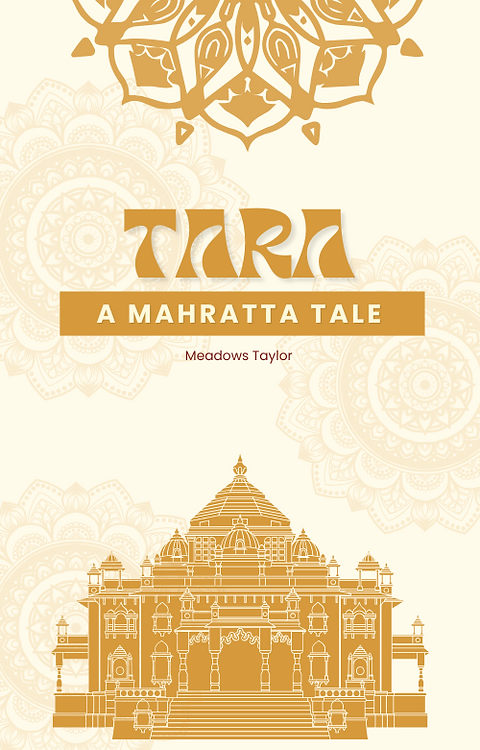

Meadows Taylor, Tara: A Mahratta Tale
Free Sample
CHAPTER I
"Tara, O Tara! where art thou?"
"Mother, I am here. Is it time?"
"Yes; we should go with the offerings to the temple. Come, thy father hath long been gone, and it will be broad day ere we can reach it. Come," said her mother, entering a small open verandah which skirted the inner court of the house, where the girl sat reading by the light of a lamp, now paling before the dawn which was fast spreading over the sky.
She shut her book with a reverential gesture, laid it aside in its quilted cover, and stood up. How beautiful she was! Let us describe this Brahmun girl to you, O reader! if we can, and tell you a little concerning her.
There were many fair women of her sect in Tooljapoor, and they are always the most remarkable of their country-women, but none so fair as Tara, the daughter of Vyas Shastree.[1] From her earliest childhood she had given promise of grace and beauty, and since that period—from the time when, hanging shyly to the skirt of her mother's garment, she passed daily through the crowded bazaar and street which led to the upper gate of the temple—to the present, she had ever been an object of remark and admiration; while the rank and learning of her father, and his position as chief priest, had maintained for her a continued and increasing interest as she grew up. None who had the privilege of addressing her ever omitted a loving greeting or respectful salutation: the public flower-sellers intrusted her with their choicest garlands or nosegays to offer up at the shrine—the confectioners had ever a delicate sweetmeat with which to tempt the child—and even the rudest peasant or soldier looked at her, as she passed him, in wonder, stretched out his hands to her, and kissed the tips of his fingers in a worshipful salutation and benediction.
[2]
The promise of the child was more than fulfilled in the girl now budding into early womanhood; and her appearance was so remarkable that, while many of her old friends in the bazaar now rarely ventured to accost her, and even turned aside their heads reverently as she passed, she could not traverse the crowded street which led from her house to the temple, or, indeed, move anywhere during the day without attracting admiration from the crowds of strangers who, from all parts of India, visited that renowned shrine of which her father was the chief priest and manager. Many a pilgrim and worshipper gazed wonderingly upon the calm, gentle face which met him at the earliest dawn in its devotional perambulation round the temple, or followed with his eye the graceful figure which, carrying the daily sacrificial offerings, descended the flights of steps by which the shrine was approached; and, far away in his native village, under the snows of Himalaya, the burning sands of Raméshwur, or the green plains of Bengal, told of the beautiful vision, and never forgot it.
Tara has been up since before the false dawn. She has assisted her father with water to bathe, and in his private worship of the household gods. She has bathed herself, and is now dressed in the simple saree, or robe of all Hindu females. It is of dark blue silk, striped with a fainter blue, and has a broad border of a light but rich pattern harmonizing with the colours of the garment which, consisting of one long piece only, is wound round her several times to form a skirt, then passed about her body and over her head on the left side, whence the end, which is of rich gold tissue interwoven with crimson flowers and green leaves, hangs heavily over her right shoulder and back. Below the garment is a closely-fitting bodice of striped orange silk only; but no portion of it is visible except a little of the sleeve above the elbow. Tara is holding the border of her dress close to her cheek, as if to conceal it even from her mother; and the graceful outline of her arm may be followed, from the tips of the taper fingers past the wrist partly covered with purple bangles and a massive gold ring, along the soft round arm to the dimpled elbow, whence it is lost among the folds of the saree which falls over it.
Do you expect that her complexion will be fair like that of our own northern girls? Ah, no! that would not harmonize with the dress or the country; and yet it is very fair. Not a deep rich olive, but what seems at a first glance pale and colourless; yet the skin is so glossy and transparent that the warm glow of her blood is suffused under it with the least passing emotion or excitement, which, as it fades, leaves, as you think, a more beautiful tint behind.
And the features harmonized with the colour. To a casual observer their expression was almost one of habitual sadness, yet it[3] was not so in reality: there was calm, which as yet had known no rude ruffling—a sweetness that was index to a simple, loving, trustful mind. True, she had cares beyond those of ordinary household occurrences, and these had no doubt increased the pensive expression always remarkable. So her countenance was not easy to describe: nor could you account very well for the patient, care-enduring look which met you from one so young. What every one saw first, were the soft brown eyes, shaded with long eyelashes which rested upon the cheek. Ordinarily perhaps, or if seen when cast down, these eyes appeared nowise remarkable; yet if passing emotions were noticed, they closed when she was merry, till only a bright spark of light remained glistening through the long lashes; and again, if surprise, wonder, or admiration were excited, they suddenly expanded, so that one looked into a depth of clear glowing colour, violet and brown, the expression of which could not be fathomed. But habitually they were modest, pensive, and gentle—full of intelligence, and seemed to correspond with a low musical cadence of voice perfectly natural, yet assisted, perhaps, by the habit of reading and studying aloud, which she had learned from her father. In those calm eyes there was as yet no passion of any kind. Some suffering, perhaps, but no rough awakening to the reality of life.
The rest of her face left nothing to be desired. The Brahmuns of Western India usually possess features more European in their character than those of the same sect in other parts of the country, and in this respect the women share them with the men, if they do not, indeed, exceed them. So Tara had a soft oval face, with small full lips and mouth, a thin straight nose with nostrils almost transparent, which seemed to obey the passing emotions of her countenance. Though the features were soft, they were neither insipid nor weak in character; on the contrary, they appeared full of a woman's best strength—endurance and patience; while, in the full glossy chin and throat, enough of determination was expressed to show firmness and consistency of no common order. Except the eyes, perhaps, there was no feature of the face which could be called exactly beautiful, yet the whole combined to create an expression which was irresistibly interesting and charming; and where all harmonized, separate portions were not remarked.
Every movement of her lithe form was displayed by the soft silk drapery which fell over it in those graceful folds which we see expressed in ancient statues, and it was cast in those full yet delicately rounded proportions which sculptors have best loved to imitate. Standing as she was, the girl had fallen into an attitude which was most expressive: her head raised and turned to meet her mother's entrance: a delicate naked foot, with a chain anklet of gold resting on it, put out from beneath her robe: her eyes open, yet not to their[4] full width: and her lips apart, disclosing the even glistening teeth:—she appeared, in her arrested movement, as if she waited some further communication from her mother, or had herself one to make before she stirred.
No wonder that, as each morning she left the house with her mother to pay her devotions at the temple, and passed along with downcast eyes, her graceful figure attracted increased attention day by day. Many a good wish followed her—many a benediction from the aged poor of the town, to whom her charities were liberally dispensed; and it might be, too, that other admiration, less pure in its character, also rested upon her, and often, unknown to her, dogged her steps.
The contrast between Tara and her mother was in most respects a striking one. No one could deny that Anunda Bye was a handsome woman; her neighbours and gossips told her so, and she quite believed it. She looked, too, very young of her age; and as she sailed down or up the street leading to the temple, and received the humble salutations of shopkeepers, flower-sellers, and all the tradesmen of that busy quarter, with an air which plainly showed how much she considered it due to her rank and station—it would have been difficult to say whether the timid girl following her, and screening her face from the gaze of the people as she moved along, was her daughter or youngest sister. Either she might be, and it seemed more probable the latter, than the former.
Taller than her daughter as yet, Anunda Bye was not without much of the same grace of figure; but it was cast on a bolder scale. The features were more decided and prominent, the colour several shades darker. The face, handsome as it was, had little of the softening element of intellectuality in it; and Anunda was ignorant of everything but household management, in which she excelled, in all departments, to a degree that made her the envy of her female acquaintance, and her husband the envied of his male associates whose domestic affairs were not conducted with the same regularity, and whose cookery was not so good.
Enter the Shastree's house at any time, and you were at once struck with its great neatness. The floor was always plastered with liquid clay by the women-servants when he was absent at the temple for morning worship, and retained a cool freshness while it dried, and, indeed, during the day. It was generally decorated by pretty designs in white and red chalk powder dropped between the finger and thumb, in the execution of which both mother and daughter were very expert and accomplished. The Shastree's seat, which was, in fact, a small raised dais at one side of the large room, was usually decked with flowers, while upon the floor before it, the greatest artistic skill was expended in ornament by Tara and her[5] mother. Above it were pictures of favourite divinities, painted in distemper colour: the amorous blue-throated Krishna playing to the damsels of Muttra; the solemn four-armed Ganésha, sitting with a grave elephant's head on his shoulders; the beautiful Lakshmee and Suruswuti, the goddesses of wealth and learning, the objects of household adoration: and the terrible six-armed Bhowani in her contest with the demon Mahéshwur, in commemoration of which the temple had been erected—all surrounded by wreaths of flowers interwoven with delicate border patterns;—had been partly executed by the Shastree himself, and partly by Tara, who followed his tastes and accomplishments after a pretty fashion. Thus decorated, the dais had a cheerful effect in the room: and choice and intimate friends only were admitted to the privilege of sitting upon it.
The house itself was perhaps in no degree remarkable. Outside, facing the street, was a high wall, with a large door within a projecting porch or archway, which had a seat on either hand as you entered. The door-frame was richly carved, and on each side a horse's head projected from the upper corner.
You've reached the end of the free sample
—but don't leave the story unfinished now!
For less than the price of a coffee, unlock this book and everything else on our platform with a Reader Plan. You won't be able to stop thinking about what happens next, so get full access today and keep reading—you know you want to read more, and now is the perfect opportunity to start your reading habit, so join now!
⭐ Special Offer: Get 20% Off Your First Month! ⭐
We love people who love reading, so we want to reward you.
Write us a quick testimonial about your experience and lock in 20% off your first month—just because you're a real reader. Share your thoughts and start saving today!