
HASALYNX
PRESS
HASALYNX PRESS
Read Romance Ebooks Legally — Anytime, Online, With a Monthly Subscription
Hasalynx Press is a digital‑first romance publishing house offering a curated library of original, high‑quality romance ebooks you can read online with a simple monthly membership.
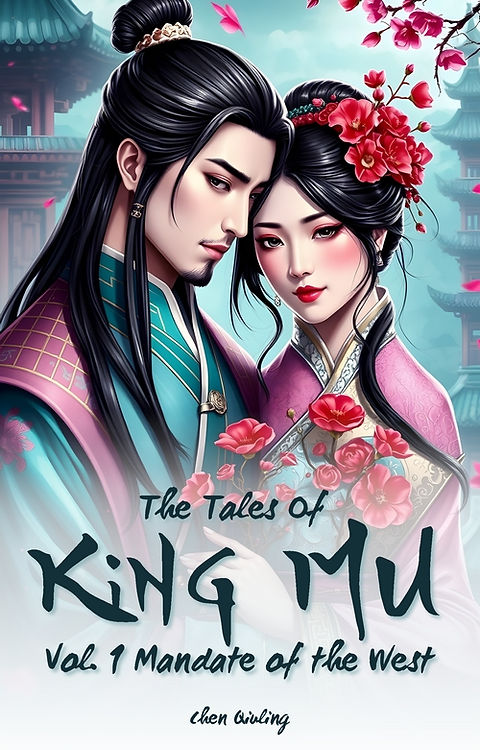

Chen Qiuling
The Tales of King Mu: Vol. 1. Mandate of the West
Historical Fantasy, Xianxia Fantasy, Epic Fantasy,
⭐ You Are Currently Reading:
Chen Qiuling, The Tales of King Mu, Vol. 1. The Mandate from the West, Part 1.
You can finish reading this text in 1-2 hours. And if life gets in the way, that's okay—reading is a habit, not a race.
Let yourself get lost in the story, one page at a time. The book will be here whenever you are.
Table of Contents:
A Word from the Author
Chapter 1. King Mu's Dimming Mandate Prompts Western Quest
Chapter 2. Oracle Bones and Tribal Scout Forge Alliance
Chapter 3. Jade Chariots and War Drums Sound Departure
Chapter 4. Mountain Spirits Accept Offerings at Mount Xing
Chapter 5. Swollen River Teems with Drowned Spirits' Wrath
Chapter 6. Kai's Blood Sacrifice Calms the Spectral Torrent
Chapter 7. Qin Melody and Quanrong Blizzard Clash
Chapter 8. Demon-Wolf Hunt Breaks the Shaman's Spell
Chapter 9. Northern Plains Host Champion's Single Combat
Chapter 10. Mu's Blade Shatters Batur's Spirit Channels
Chapter 11. Poison-Tested Feast Forges Unspoken Brotherhood
Chapter 12. Whispered Doubts and Yu Pass Reality Shift
Chapter 13. Luminescent Forests and Dreamlike Geography Unfold
Chapter 14. Leopard Skins and Celestial Steeds Received
Chapter 15. Fishing and Hunting Reveal River's Testing Gaze
Chapter 16. Six Armies Array to Impress the River God
Chapter 17. Waters Part for Mu's Divine Audience
Chapter 18. Dark Instruction Granted, Kunlun Beckons
Chapter 19. Jade Fruits, Silver Light, and Spirit Beasts Catalogued
Chapter 20. Liquid Qi Waters the Eight Divine Steeds
Chapter 21. Mu Fears His Pleasures, Troops Oath Their Loyalty
A Word from the Author:
"The Tales of King Mu: Vol. 1. Mandate of the West" is the first volume in a six-book xianxia historical fantasy series that reimagines the legendary journey of King Mu of Zhou.
The original text from the classical Chinese tradition is called the "Mu Tianzi Zhuan" (穆天子传), which translates to "Biography of the Son of Heaven Mu" or "The Tales of King Mu, Son of Heaven." The version used was annotated by Guo Pu of the Jin Dynasty and edited by Fan Qin of the Ming Dynasty, and is now fully in the public domain. The original was a sparse chronicle of dates, gifts, and ritual actions—a dry administrative record that told us what happened but never who the people were, never why they endured such hardship, and never how they felt as they crossed into the realm of gods.
This series will adapt the complete epic, following King Mu and his companions from the failing courts of the Zhou Dynasty to the very axis of the world itself. This book transforms that ancient framework into a sweeping xianxia fantasy adventure. I have expanded the skeletal narrative into a rich, character-driven epic: adding a magic system rooted in Qi cultivation, spiritual cultivation, and divine politics; introducing thrilling action sequences against demon-possessed beasts and hostile shamans; deepening the relationships between King Mu and his companions; and strengthening the cast into a fellowship of five distinct, memorable characters—each with their own flaws, fears, and hidden strengths.
It reads like an epic fantasy novel of xianxia, blending the authenticity of classical Chinese mythology with the pacing, excitement, and emotional depth of modern fantasy storytelling. The remaining five volumes will continue the journey, carrying readers through the full adaptation of the "Tales of King Mu" and into the mysteries of Kunlun and beyond.
Chapter 1. King Mu's Dimming Mandate Prompts Western Quest
The weight of Heaven pressed down upon King Mu's shoulders as he stood at the edge of his palace gardens, gazing westward where the sun bled its elusive colors across the horizon. The jade crown upon his topknot felt heavier with each passing day, each whispered report, each ominous sign in the heavens. Something was unraveling in the world—the sacred threads that bound the Zhou Dynasty to the divine will were fraying, and he alone could feel every snapped strand like a physical wound across his spirit. The Celestial Mandate that gave him the right to rule was wavering, and with it, the very foundations of the kingdom trembled on the precipice of chaos.
Behind him, the palace hummed with anxious activity. Servants moved like shadows, their eyes downcast, their footsteps deliberately light as if afraid to disturb the fragile equilibrium of power. They knew, as did everyone in the court, that something was terribly wrong. The patterns of fate had shifted; the harmonious balance between Heaven and Earth was distorted.
Mu closed his eyes, feeling the faint pulse of the dragon veins beneath the earth—those sacred channels of Qi that sustained the Middle Kingdom. Once strong and steady as a heartbeat, they now fluttered erratically, weakened by some unseen corruption. At the edges of his awareness, he sensed the northern barbarians stirring, their shamans somehow feeding on this weakness, drawing power from the disorder. Their Qi was a cold, hungry presence at the borders of his consciousness.
"Son of Heaven," came a soft, reverent voice behind him. "The court astrologers request an audience."
Mu did not turn immediately. His dark brown eyes remained fixed on the western mountains, distant and purple in the fading light. "Send them to the Moon Hall. I will hear them shortly."
The servant bowed low and retreated, leaving the king alone with his thoughts once more. Mu's fingers unconsciously found the jade tablet at his girdle, his thumb tracing the ancient inscriptions that granted him authority. The stone felt cold beneath his touch. Even the sacred jade, it seemed, sensed the coming storm.
In the Moon Hall, the astrologers waited with charts of beaten silver and bamboo scrolls spread across lacquered tables. Their faces were drawn, their usual scholarly composure fractured by genuine fear. As Mu entered, they bowed as one, the movement stiff with tension.
"Speak," Mu commanded, seating himself upon the simple throne. The word hung in the air, weighted with expectation and dread.
The Chief Astrologer, an ancient man whose beard reached his waist, stepped forward. His hands trembled as they unfurled a star chart marked with vermilion ink.
"The celestial signs are... unprecedented, Son of Heaven," he began, his voice thin with age and worry. "The Star of the Emperor dims while the Northern Dipper tilts away from our lands. The Yellow River runs cloudy even at its source—a sign that the Dragon King himself turns his face from the Zhou."
Mu's expression remained impassive, though inside, his heart clenched. "And your interpretation?"
The old man swallowed visibly. "It is a fact that the Mandate of Heaven wavers, my king. The spirits no longer recognize your divine right to rule with certainty. Without clear heavenly favor..." He trailed off, the consequences too dire to voice aloud.
What remained unspoken was understood by all present: without the Mandate of Heaven, the Zhou Dynasty would collapse. Civil war would erupt as ambitious lords vied for power. The barbarian tribes would pour over the borders like a flood, and the sophisticated civilization built over centuries would crumble into bloodshed and chaos.
"There is more," another astrologer added, her voice barely above a whisper. "The shamans of the Quanrong tribe have increased their sacrifices. They draw power from the uncertainty. Their Qi grows while ours falters."
Mu stood abruptly, silencing the room with his movement. "Then we must act decisively," he declared, turning back to face them. "Not with armies alone, but with spiritual authority."
The decision crystallized in his mind, clear and irrevocable. For weeks, he had sensed this moment approaching, had felt the subtle nudges of destiny guiding him toward a singular conclusion. Now, facing the tangible evidence of his kingdom's peril, there was no longer any doubt.
"I will undertake the Great Western Expedition," he announced. "I will journey to the source of the Yellow River and secure a blessing from the River Earl himself."
A murmur rippled through the assembled scholars. Such a journey was unprecedented in living memory—a king leaving the safety of his realm to seek divine intervention directly. And yet, in this moment of crisis, it seemed the only possible recourse.
"The River Earl controls the waterways and Qi of the west," Mu continued, his voice gathering strength as he spoke. "His public blessing would be undeniable proof of Heaven's favor. It would strengthen our dragon veins and silence those who question my right to rule."
The Chief Astrologer nodded slowly, understanding dawning in his rheumy eyes. "A direct divine endorsement... yes, it could mend the fraying Mandate. But the journey will be perilous, your majesty; filled with tests both physical and spiritual."
"So be it," Mu replied defiantly. His hand moved to the hilt of his sword, an ancestral blade that had tasted the blood of both men and spirits. "I am the Son of Heaven. If I cannot face such trials, I am unworthy of the throne I seek to protect."
*
Upon announcing this decision, the palace transformed into a hive of purposeful activity. Royal craftsmen worked day and night forging ceremonial weapons and armor infused with protective spells. Court sorcerers prepared talismans and purification rituals for the journey ahead. The treasury opened its vaults, selecting the purest jade and gold for divine offerings.
In his private chambers, away from the watching eyes of the court, Mu allowed himself a moment of vulnerability: he stood before the ancestral shrine, the flickering lamplight casting his shadow long and distorted across the floor.
"Grandfather," he whispered to the spirit tablet of the previous king. "I will go to save what you built. Guide my steps through the wilderness beyond the maps."
The lamp flames bent slightly, though no wind stirred in the closed room. Perhaps it was merely a coincidence; perhaps it was acknowledgment from beyond the veil...
That night, as the palace slept, Mu dreamed of the Yellow River—not the mundane waterway that sustained crops and cities, but its divine aspect. In the dream, the river was a gleaming serpent of liquid gold, its coils stretching from the western mountains to the eastern sea. At its source stood a figure too bright to look upon directly, crowned with the antlers of a stag and robed in flowing water.
The River Earl. The god whose favor Mu must win to save his kingdom.
This journey was not merely about political survival or even the fate of the Zhou Dynasty. It was about restoring the proper order between Heaven and Earth, about healing the wounded dragon veins that carried life-giving Qi throughout the land. For if the Mandate of Heaven truly fell, it would not be kings alone who suffered, but every soul in the Middle Kingdom.
Chapter 2. Oracle Bones and Tribal Scout Forge Alliance
Dawn spilled across the eastern chamber where Lady Sheng Ji knelt before her wooden divination board, her slender fingers arranging polished oracle bones with practiced precision. The pale morning light caught in her neatly bound hair, creating a soft halo around her scholarly countenance. Her hazel-colored, intelligent eyes narrowed in concentration as she interpreted the patterns before her, searching for Heaven's guidance on the perilous journey ahead.
As Record-Keeper of Auspicious Signs, her duty was clear—to observe, to document, to interpret—yet the weight of this particular expedition pressed upon her spirit with unprecedented urgency. The fate of the dynasty now partially rested in her hands; one misinterpreted omen could mean disaster for all.
She traced the delicate cracks in the bone, following their branching paths with a reverent touch. The patterns were auspicious—a favorable indication for the journey's beginning—but complex, suggesting trials and transformations yet to come.
Sheng Ji had been born with a rare sensitivity to the whispers of the divine. Where others might see random patterns, she perceived the subtle language of spirits and celestial forces. It was a talent still developing, still occasionally raw and unpredictable, but essential for the King's quest.
"Another reading?" A deep voice broke her concentration, rich with the accent of the southern jungles.
She did not need to look up to know who stood in her doorway. Kai's presence filled any space he entered, wild and untamed as the forests of his homeland. Nevertheless, she raised her eyes to meet his, acknowledging his arrival with a small nod. "The signs change with each passing hour," she replied, carefully gathering the oracle bones into a silk pouch. "What was clear at midnight may be clouded by dawn."
Kai moved into the room with the silent grace of a predator, his tribal tattoos stark against his bronze skin. Unlike the refined, robed scholars of the court, he wore only a sleeveless tunic of undyed hemp that revealed the powerful muscles of his arms, plus a pair of pants. His hair, falling loose past his jawline, was a deliberate rejection of Zhou styles, just as his permanent expression of wary assessment was a contrast to courtly masks of politeness.
"So, what do the bones say today?" he asked, making no attempt to hide his skepticism. "Do they tell you which spirits will try to devour us first?"
Sheng Ji's lips curved in a small, patient smile. After months in his company, she had grown accustomed to his blunt manner. "If you have to know, they tell me our journey begins under favorable stars, but we must remain vigilant: the path will twist in ways we cannot yet foresee."
Kai grunted, absently touching the wolf's tooth that hung around his neck. "My people don't need bones to tell us that. The wind carries warnings, the birds fall silent before danger. We believe that these are the signs that matter in the wild."
His words carried no malice, merely the certainty of a man who trusted his senses above all else. This was the essential tension between them—her scholarly approach to the divine and his instinctive, primal connection to it. Yet it was precisely this complementary perspective that made their pairing valuable to the expedition.
And a pairing they would permanently be. Their betrothal wasn’t a personal arrangement; it was a living symbol of the alliance between the Zhou court and the powerful "Jungle Tiger" tribe. A marriage that would bind Kai's people to the King's interests, ensuring their warriors would not threaten the kingdom's southern borders. It was politics wrapped in the guise of romance—though romance had little to do with it.
"The soldiers fear you," Sheng Ji observed, rising gracefully to her feet. She was small beside him, the top of her head barely reaching his shoulder, yet there was nothing frail about her presence. "They believe you can speak to the beasts of the forest."
Something like amusement flickered in Kai's amber eyes. "If so, let them believe it: fear makes them respectful."
"And can you? Speak to beasts?" She wouldn’t give it up.
Kai moved to the window, gazing out at the bustling courtyard where preparations for the expedition continued. "Not in words, Sheng Ji... But, I understand their hunger, their territory, their intentions; just as I understand the hunger and intentions of men." He glanced back at her. "It's why your King needs me. His maps end where the true wilderness begins."
Sheng Ji joined him at the window, maintaining a proper distance. The morning sun illuminated the scene below—servants loading provisions, soldiers checking weapons, sorcerers preparing talismans. The scale of the expedition was enormous, a testament to its importance.
"This journey is more than a military campaign," she said quietly. "We go to heal the very spirit of the kingdom. The River Earl's blessing would strengthen the dragon veins, restore the flow of Qi through the land."
Kai's expression remained skeptical, but he nodded. "My people feel it too—the sickness in the earth. The water spirits grow restless, the forest guardians withdraw... Something is out of balance, indeed."
This admission surprised her. It was rare for him to acknowledge common ground between his tribal beliefs and the Zhou cosmology. "Then we share the same goal, if through different paths," she smiled at him.
"Perhaps," he conceded with a shrug. "Though I go because my chieftain commanded it. And to ensure your safety, as is my duty as your betrothed."
The word hung between them, neither comfortable nor entirely unwelcome. Their arranged marriage would solidify the alliance between their peoples, a political necessity that both had accepted with pragmatic grace. Yet sometimes, in unguarded moments like this, Sheng Ji glimpsed something more complex in his gaze—a reluctant respect, perhaps, or curiosity about the woman who would one day be his wife.
"The journey will be dangerous," she said, changing the subject back to the safe waters. "The King seeks not just to defeat human enemies, but to navigate the realm of spirits. I suppose that your knowledge will be just as vital as my readings."
Kai’s eyes met hers with unexpected directness. "Your court magicians draw their power from scrolls and rituals, Sheng Ji. Meanwhile, my people draw strength from the land itself, from the spirits that dwell in every tree and stone. So, when your scholars' incantations fail—and they will fail—remember that there are older ways."
There was pride in his voice, but also a sincere warning. Sheng Ji inclined her head, acknowledging the truth in his words, though it cost her a lot of patience. "I will remember your words, Kai. I plan to record both approaches in my scrolls, that future generations might learn from our journey."
A faint smile ghosted across his lips—rare enough that she found herself momentarily transfixed by the sight. "Always the scholar," he said, and for once, there was no mockery in his tone. "Gathering wisdom like a bee gathers nectar."
Before she could respond, perhaps with irritation, a gong sounded from the central courtyard—the signal for final preparations. The moment of understanding between them receded like morning mist before the sun.
"It is time," Sheng Ji said, gathering her divination tools and the blank scrolls that would record their journey. "The Son of Heaven awaits."
Kai nodded, his expression once again becoming the impassive mask he showed to the world. However, as they left the chamber together, Sheng Ji noticed how he positioned himself slightly ahead of her, his keen eyes scanning for any sign of threat. Protection came naturally to him, whether commanded or not. Perhaps, she reflected, that instinct would serve them all in the wilderness ahead, where court protocol would mean nothing against the ancient spirits they sought to petition.
Together, the scholar and the warrior-scout descended to join their king, each carrying the knowledge and skills that would guide the expedition through the spirit-haunted wilderness that lay between the mortal realm and the dwelling of the River Earl. Their path forward was as uncertain as the relationship between them—bound by duty, complicated by difference, yet potentially stronger for both.
Chapter 3. Jade Chariots and War Drums Sound Departure
The expedition assembled in the outer courtyard as the first fingers of dawn stretched across the sky, painting the clouds in pearlescent hues. Hundreds of soldiers stood in perfect formation, their armor gleaming in the early light, while attendants scurried between them, making final adjustments to provisions and equipment. The air hummed with a strange duality—the practical sounds of men preparing for a journey overlaid with the ethereal chants of court sorcerers blessing weapons and inscribing protective characters on banners. It was neither wholly military nor entirely religious; it was a pilgrimage with teeth, a spiritual quest defended by steel and blood.
At the center of this ordered chaos stood the royal chariot, a masterpiece of craftsmanship adorned with jade inlays and bronze fittings that caught the sunlight like captured stars. Upon this mobile throne stood King Mu, the Son of Heaven, his posture rigid and his gaze fixed westward. The silver crown that marked his divine right to rule sat heavy on his topknot, and his robes—layers of the finest silk in imperial black embroidered with gold—billowed slightly in the morning breeze. He stood apart from the activity surrounding him, physically present yet spiritually elsewhere, as if already communing with the distant powers they sought to petition.
Beside the chariot, murmuring softly to the four white horses harnessed to it, was Zaofu, the royal charioteer. His weathered hands moved with gentle assurance over the animals' flanks, his silver-streaked beard swaying as he whispered words meant only for equine ears. Though well past fifty, his body retained the sturdy strength of a man who had spent decades mastering the reins, guiding royal chariots over terrain from palace courtyards to mountain passes.
"They sense the importance of this journey," Zaofu said, looking up at his king with eyes crinkled by decades of sun and wind. "Horses always know when a path leads to destiny rather than merely another palace."
King Mu acknowledged the observation with the barest inclination of his head. "Then they must also sense the dangers that await us. Can they carry us through, old friend?"
"Through fire and flood, over mountains and across rivers haunted by hungry ghosts," Zaofu replied, his confident tone belying the gravity of his words. "My skill and their strength will not fail you."
A short distance away, positioned deliberately between the soldiers and the court officials, Lady Sheng Ji observed the preparations with scholarly intensity. A wooden writing board rested in her hands, and a brush moved swiftly across its surface, recording every detail—from the precise arrangement of the expedition to the flight patterns of birds overhead, which might contain omens about their journey. Her dark eyes missed nothing, cataloging the world with the precision of one who understood that history was made not just of grand gestures, but of countless small moments, properly interpreted.
She paused in her writing, noting how the morning light caught in the silver thread of her sleeve—an auspicious gleam, perhaps. The divine often spoke through such subtle manifestations, and it was her duty to notice and record them all. A proper interpretation now might save lives later, when they faced trials beyond the maps.
At the perimeter of the assembly, moving with the silent grace of a hunting cat, Kai prowled. Unlike the Zhou soldiers with their polished armor and disciplined formations, he wore only light leathers over his tribal garments, allowing for swift movement and silence. His amber eyes constantly scanned the surroundings, not just for physical threats, but for the signs his people had taught him to recognize—a crow flying counterclockwise, the unnatural stillness of leaves, the sudden silence of insects. His distrust of the Zhou court was a palpable force, etched into the tension of his shoulders and the way his hand never strayed far from the bone-handled knife at his belt.
A Zhou officer approached him, clearly uncomfortable with the tribal scout's presence. "The formation is ready to move out. You should take your place—"
"My place is wherever danger might approach first," Kai interrupted, his voice low and firm. "Not where your maps say I should stand."
Before the officer could respond, a booming laugh cut through the tension. Gao Benrong, commander of the Seven Elite Troops, strode toward them with the confident gait of a man accustomed to both battlefield and banquet hall. His broad frame was encased in lamellar armor that clinked with each step, and his gap-toothed grin flashed beneath his magnificent beard.
"Let the Tiger scout as he sees fit," Benrong declared, clapping the officer on the shoulder with enough force to make him stumble. "His eyes have saved Zhou lives before, and will again before this journey ends." He turned to Kai, his expression sobering slightly. "Though the men would feel more at ease if you joined us for the morning rice, rather than watching us like we might grow fangs at any moment."
Kai's expression remained impassive, but something like reluctant respect flickered in his eyes. "When men grow complacent, that is precisely when fangs appear," he replied, though the edge in his voice had softened marginally.
Benrong laughed again, the sound echoing across the courtyard and drawing smiles from nearby soldiers despite the gravity of the occasion. It was his gift—to ease tensions with well-timed humor, to remind men that even on sacred quests, they remained human. He moved among the troops, offering words of encouragement, inspecting equipment with a practiced eye, his presence a counterbalance to the somber mood that had settled over the expedition.
In this gathering, the contrasts were stark and telling. King Mu stood aloof and regal, carrying the weight of dynasty and divine mandate. Zaofu tended to his horses with quiet confidence, his connection to the animals as important as any sorcerer's link to the spirit world. Sheng Ji observed and recorded, her scholarly mind bridging the gap between heavenly signs and earthly actions. Kai maintained his distance, trusting instincts honed in the wilderness over courtly protocol. And Benrong moved through it all, his laughter a futile but valiant attempt to dispel the tension that hung over them like a storm cloud.
They were more than individuals; they were representations of the different aspects of the kingdom itself—divine authority, practical skill, accumulated wisdom, primal instinct, and martial strength. Together, they might succeed where any single approach would fail.
A gong sounded three times, its deep resonance cutting through all other noise. The court herald stepped forward, unrolling a scroll bearing the royal seal.
"By decree of King Mu, Son of Heaven and Keeper of the Mandate, the Great Western Expedition commences this day," he announced, his voice carrying to every corner of the assembly. "Our first destination is the sacred peak of Mount Xing, where we shall perform the Rites of Ascension and seek Heaven's blessing for our journey."
A murmur passed through the gathered soldiers and attendants. Mount Xing was known to all as a place where the veil between worlds grew thin, where ancient spirits dwelled among jagged peaks. It was a fitting first trial—not merely a physical challenge, but a spiritual threshold to cross.
King Mu raised his hand, and silence fell instantly. "We journey not merely for conquest or glory," he declared, his voice resonating with calm authority. "We go to heal the very foundations of our kingdom, to restore the proper flow of Qi through the dragon veins of our land. Each of you has been chosen because your skills and your spirit are necessary for this sacred task."
His eyes moved across the gathering, briefly meeting those of each member of his core group—Zaofu, Sheng Ji, Kai, Benrong—before returning to address the whole.
"The trials ahead will test not just your bodies, but your souls," he continued. "We will face dangers both seen and unseen. But we go with the weight of dynasty behind us and the favor of our ancestors before us."
As if in response to his words, a breeze swept through the courtyard, setting the expedition banners rippling. Sheng Ji's brush moved quickly across her tablet, recording the moment—an auspicious sign, the wind from the east carrying them toward the west.
Zaofu clicked his tongue softly, and the white horses stomped in unison, eager to begin. Kai's eyes narrowed as he scanned the horizon one final time, while Benrong straightened his back, his jovial expression giving way to the focus of a commander preparing for battle.
It was time. The Great Western Expedition would now begin its journey toward Mount Xing, the first step on a path that would determine the fate of the kingdom and test the limits of what mortals could achieve in the realm of spirits.
Chapter 4. Mountain Spirits Accept Offerings at Mount Xing
Mount Xing loomed before them like a colossal deity of stone and mist, its jagged peaks piercing the afternoon sky as if to wound the very heavens. The expedition had traveled for seven days to reach its hallowed base, where ancient pines grew twisted by generations of spirit winds. No ordinary mountain, this was a threshold between worlds—a place where the membrane between the mortal realm and the divine thinned to gossamer. As the company made camp in its shadow, even the most battle-hardened soldiers moved with unusual care, their voices hushed, their gestures measured. They understood, without being told, that they had entered a domain where different rules applied, where careless words or actions could awaken forces beyond mortal comprehension.
The mountain itself seemed alive, watching them through a thousand eyes of stone. Clouds clung to its middle reaches, writhing slowly like celestial serpents. Occasionally, strange cries echoed from the higher slopes—sounds that might have been birds, might have been spirits, might have been the mountain itself sighing at the audacity of mortal visitors. The air tasted different here, heavy with pine resin and something older, something metallic and sharp that tingled on the tongue like the precursor to lightning.
"The spirits are aware of us," Sheng Ji murmured, standing at King Mu's side as they surveyed the campsite. Her eyes traced the outline of the mountain, noting how certain peaks aligned with constellations that would be visible after nightfall. "They have been watching since we crossed the last river."
The King nodded, his face betraying nothing of his inner thoughts. "Then we must make them welcome us. Begin the preparations."
At his command, the camp transformed. This was not the hasty establishment of a military outpost, but the careful creation of a sacred space. Court geomancers moved through the area, placing markers of polished jade at specific points to create an invisible diagram of power. Soldiers unloaded not weapons but ceremonial objects—bronze tripods, silk banners in the five sacred colors, vessels of wine that had been aging since the founding of the dynasty.
Under Gao Benrong's direction, a clearing was established at the exact center of their encampment. Here, a platform of flat stones was assembled, forming an altar that faced the most imposing of the mountain's peaks. Upon this platform, the feast for the spirits would be laid.
"The stones must touch only at their edges," Zaofu instructed the soldiers, his usual calm demeanor intensified by the solemnity of the occasion. "Leave space between them for the spirits to breathe through the earth."
Kai watched these preparations with narrowed eyes, his body tense as a drawn bow. Unlike the Zhou, who approached the divine through elaborate ritual, his people communed with spirits through direct, primal connection. Nevertheless, he recognized the power gathering in the air—an electric anticipation that made the fine hairs on his arms stand on end.
"Your tribe has its own ways of greeting the mountain spirits?" Sheng Ji asked him, her brush poised over a scroll as she documented the preparations.
Kai glanced at her, surprised by her interest in his traditions. "We offer blood and song," he replied after a moment. "Direct. Honest. No elaborate tricks or fancy words."
"Not tricks," she corrected gently. "Different languages for different spirits. The mountain guardians here are ancient. They remember the time before the first dynasty. They expect certain courtesies."
Before he could respond, a gong sounded, signaling the beginning of the ritual. The sun was beginning its descent, casting long shadows across the clearing. Now was the time—the hour when day and night balanced on a knife's edge, when the veil between worlds grew most permeable.
King Mu emerged from his tent, transformed. Gone were the black imperial robes of the court; instead, he wore garments of undyed silk, simple yet impeccably crafted. Around his waist was a girdle of white jade, and upon his brow, a single band of gold rather than his usual crown. He had become not the Son of Heaven addressing his subjects, but a supplicant approaching higher powers.
Behind him came his closest attendants, each bearing elements of the feast. Platters of rare delicacies—white crane cooked with ginseng, river fish prepared with herbs that grew only in sacred groves, rice wine infused with chrysanthemum blossoms—were carried reverently to the stone platform. The aromas blended in the mountain air, creating a fragrance that was simultaneously earthy and ethereal.
Gao Benrong supervised the placement of each dish with uncharacteristic quietude, his usual boisterous manner subdued by the weight of the ritual. Even he, a man who had faced countless battles without flinching, seemed to feel the otherworldly pressure of the mountain's gaze.
"This is not merely food," King Mu declared, his voice pitched to carry to his companions but not disturb the listening silence of the mountain. "It is acknowledgment. It is respect. It is our recognition that we pass through domains not our own, and seek permission rather than assuming right."
He approached the altar, kneeling before it on a mat of woven reeds. With practiced movements, he poured the first libation of wine onto the stones, watching as the liquid found the spaces between them and seeped into the earth beneath.
"Guardians of Mount Xing, Ancient Ones who were here before the first dynasty, hear the petition of Mu, who comes not as conqueror but as pilgrim," he intoned, the ritual words flowing with natural grace. "We seek safe passage through your domain on a journey to restore balance to the Middle Kingdom. We offer not just these gifts, but our sincere recognition of your sovereignty over these peaks."
As he spoke, a subtle change came over the clearing. The light seemed to shift, taking on a golden quality that was not entirely natural. The smoke from the censers, which had been rising straight upward, began to curl and twist into shapes that almost resembled characters from an ancient script, too old for even the scholars to decipher.
Sheng Ji observed these signs with keen attention, her brush moving rapidly across her scroll. "The spirits are listening," she whispered to no one in particular. "They are considering."
The ritual continued as the sun sank lower. Each member of the expedition approached the altar in turn, offering not just food and wine, but personal tokens of respect. Zaofu placed a carved wooden horse, a symbol of their journey. Gao Benrong offered a single arrow, representing the expedition's strength held in check. Sheng Ji contributed a blank scroll, symbolizing the unwritten future they sought to secure.
When Kai's turn came, he hesitated, then stepped forward with unexpected grace. From around his neck, he removed a small pouch of herbs gathered from his tribal lands. "The breath of the southern forests," he said simply, placing it among the other offerings. "One sacred place paying respect to another."
The gesture was unexpected, a bridge between traditions. Sheng Ji's eyes widened slightly at this diplomatic choice from a man she had thought disdained such niceties.
As the last of the offerings was placed, a wind swept down from the mountain heights—not a destructive gale, but a purposeful breeze that carried the scent of alpine flowers and ancient stone. It circled the altar once, twice, making the flames of the ceremonial lamps dance without extinguishing them. Then, most tellingly, it lifted the aromas of the feast skyward, drawing them up toward the mountain peaks.
"Acceptance," King Mu murmured, relief evident in the slight relaxation of his shoulders. "They will permit our passage."
This was more than mere superstition or empty ritual. Had the spirits rejected their offerings—had the wind scattered the feast or the flames extinguished—it would have signaled doom for their expedition. The mountain guardians would have turned their wrath upon the travelers, sending avalanches to block their path or luring them into ravines from which they would never emerge. The journey would have ended before it truly began.
Instead, this acceptance established the fundamental rule of their quest: this was a world where spirits and humans could negotiate, where respect opened doors that force could never breach. Their journey was not merely a physical traversing of distance, but a spiritual pilgrimage through realms where different powers held sway.
As twilight deepened into night, the expedition ate their own meal in the shadow of the mountain, now secure in the knowledge that when they began their ascent at dawn, the path—while still dangerous—would at least be open to them. The first hurdle had been cleared, the first agreement reached.
The mountain would let them pass, but what lay beyond remained veiled in mystery and mist.
Chapter 5. Swollen River Teems with Drowned Spirits' Wrath
As the final embers of the ritual fire died to glowing coals, King Mu stood among the shadows, his face illuminated by the last flickering light. The mountain spirits had accepted their offerings; their path forward was clear, if not easy. His eyes, amber and intent, sought Sheng Ji's across the ceremonial ground where disciples were now carefully removing the sacred vessels. When he found her gaze, a question passed between them without words—had the omens truly been favorable, or were the spirits merely toying with mortals as they sometimes did? Sheng Ji's response was subtle but unmistakable: a slight, almost imperceptible nod, her scholar's certainty providing confirmation where ritual alone could not. Something loosened in the King's chest at this silent exchange—a tightness he hadn't realized he'd been carrying until her quiet affirmation released it.
In the days he had known her, Mu had come to value Sheng Ji's assessments above those of his more seasoned court diviners. There was a clarity to her interpretations, unclouded by political considerations or the desire to please. When she said the signs were favorable, he believed her without reservation. It was a strange trust to have developed so quickly, yet it felt as natural as breathing.
As the ceremonial grounds cleared, Sheng Ji approached, her writing tablet tucked beneath her arm. "The mountain accepts us, my lord," she confirmed aloud, her voice low enough that only he could hear. "But it also warns us."
"Of what?" Mu asked, equally quiet.
"Of water and betrayal." Her eyes lifted to the stars, reading their positions with practiced ease. "The river crossing should not be attempted until the day of Wuyin. Earlier would bring disaster; later would miss the auspicious alignment."
Mu considered this. The day of Wuyin was three days hence—a delay, but not a significant one. "Then we shall rest here and continue our preparations," he decided. "The troops could use the time to acclimate to the altitude before we face the Zhang River."
Sheng Ji bowed slightly, approval flickering across her features. "A wise decision, Son of Heaven."
For three days, the expedition remained at the foot of Mount Xing. Soldiers trained in the thin mountain air, court sorcerers prepared talismans for the river crossing, and scouts mapped the path ahead. On the morning of Wuyin, they broke camp before dawn, the mood somber yet determined. The mountain had blessed their passage; now they would test whether that blessing extended to the treacherous waters that lay ahead.
By midday, they had descended from the foothills and arrived at the banks of the Zhang River. What greeted them was less a waterway and more a writhing serpent of liquid chaos. Spring melt from distant peaks had swollen the river to a terrifying breadth, its currents a churning, mud-brown maelstrom. But the true danger was invisible to ordinary eyes.
"The waters are thick with resentful spirits," Sheng Ji murmured to the King as they surveyed the obstacle. "Those who drowned here over centuries—soldiers, farmers, forgotten souls whose bitterness gives the river a malevolent sentience."
King Mu nodded, feeling the hostility emanating from the water even from a distance. "Then we must pacify them before attempting a crossing."
Gao Benrong approached, his armor gleaming in the afternoon sun despite the dust of their journey. "The engineers report that the riverbed is too unstable for a permanent bridge, my lord. They propose pontoons—lighter, more flexible, but more vulnerable to the current."
"And to spiritual interference," Zaofu added, joining the conversation. His weathered face was creased with concern as he studied the churning waters. "I've guided royal chariots across many rivers, but this one..." He shook his head. "This one has teeth."
"Nevertheless, we must cross," Mu said firmly. "Prepare the pontoons, but no one sets foot on them until the court sorcerers have completed their rituals."
At his command, the expedition's spiritual defenses mobilized. Robed figures took up positions along the riverbank, unfolding scrolls of protective spells and arranging ceremonial objects on small, portable altars. The air soon thrummed with the drone of their chanting, golden light weaving in visible nets above the torrent.
Soldiers watched this display with thinly veiled fear. They were brave men who would face human enemies without hesitation, but the prospect of drowning in spirit-infested waters brought a different kind of terror. Many began casting personal offerings into the river—inscribed jade tablets, small effigies of horses, even locks of hair—anything to appease the watery spirits that might otherwise drag them into the depths.
"It's not enough," Sheng Ji said, appearing at the King's side as he observed the preparations. "The river demands a more substantial offering."
"What would you suggest?" Mu asked, trusting her insight.
She hesitated only a moment. "The royal treasury carries jade of exceptional purity for diplomatic gifts. Such jade, properly consecrated and offered to the river, might calm its fury long enough for us to cross."
It was no small request. The jade she spoke of represented a small fortune, meant to impress foreign dignitaries and cement alliances. Yet the alternative was potentially losing men and equipment to the river's wrath—or worse, losing time they could not afford to waste searching for an alternate crossing.
"See it done," Mu ordered. "Whatever jade is necessary, use it."
Under Sheng Ji's direction, the court sorcerers adjusted their ritual. The finest pieces of imperial jade—discs, tablets, and beads of flawless green and white stone—were inscribed with calming characters and blessed with incantations of passage. As the sun reached its zenith, these treasures were ceremoniously committed to the river, sinking beneath the turbulent surface with flashes of ethereal light.
For a long moment, nothing seemed to change. Then, gradually, the river's roar diminished. The churning waters did not calm completely, but their rage seemed to subside from murderous to merely threatening. It was enough for the engineers to begin extending the pontoon bridges—segments of buoyant wood bound together with rope and covered with planks, stretching like a tenuous lifeline across the watery chasm.
King Mu watched with controlled apprehension as the first troops began to cross. Zaofu stood at his right hand, eyes fixed on the structural integrity of the makeshift bridge. Gao Benrong positioned himself at the crossing point, personally checking each section of troops to ensure proper spacing and weight distribution.
All seemed to be proceeding according to plan when a sudden change swept over the river. The water directly beneath the center section of the bridge began to swirl unnaturally, forming a vortex that glowed with an eerie, spectral light. The soldiers crossing that section froze, feeling the bridge shift beneath their feet.
"Something stirs in the depths," Sheng Ji whispered, her face pale. "Something the jade did not appease."
Before anyone could react, a surge of spectral energy erupted from the vortex—not water, but something more ethereal, a concentrated manifestation of spiritual rage. It struck the underside of the pontoon bridge with the force of a battering ram, splintering wood and snapping ropes. The central section began to tear away, tilting sideways as soldiers scrambled to regain their footing or leap to safer portions of the structure.
"Secure the lines!" Gao Benrong bellowed, rushing forward with a squad of elite troops to grab the trailing ropes of the failing section. Their strength alone would not be enough against the river's supernatural assault, but their quick action prevented immediate catastrophe.
The court sorcerers redoubled their efforts, chanting more urgently as they cast additional spells of binding and pacification. Sweat streamed down their faces, their robes darkening with the effort of channeling such power.
Yet the spectral energy continued to rise, manifesting now as ghostly faces in the spray and elongated, grasping hands in the currents. The damaged section of bridge groaned, hanging by only a few remaining ropes, with dozens of soldiers still trapped on its tilting surface.
"The spirits are not appeased!" a soldier cried out, his voice cracking with terror as a translucent hand emerged from the water to grasp at his ankle. All around him, similar manifestations reached for his comrades, the river's resentful dead seeking to drag the living down to join them.
King Mu stepped forward, prepared to command a retreat and reassessment, when an unexpected movement caught his eye. On the far bank, where the vanguard had already established a position, a figure moved with determined purpose toward the river's edge. Even at a distance, the tribal tattoos marking his bare arms were unmistakable.
Kai had a different approach to river spirits, it seemed. And as the Son of Heaven watched, the tribal warrior prepared to demonstrate it.
Chapter 6. Kai's Blood Sacrifice Calms the Spectral Torrent
Without a word or moment of hesitation, Kai leapt onto the unstable bridge, his movements fluid and decisive as a hunting tiger. The structure swayed precariously beneath his weight, timbers groaning as spiritual energy lashed at its foundations. Soldiers clutched desperately at the tilting planks, their faces masks of terror as they confronted a force no blade could counter. Yet Kai moved forward with absolute certainty, each step placed with preternatural precision as he made his way to the center of the failing span. The raging waters below seemed to sense his presence, the spectral faces turning their hollow-eyed gazes toward this new intruder who dared to challenge their domain. But unlike the Zhou soldiers, Kai did not flinch from their attention; instead, he welcomed it, drawing their focus like a lightning rod attracts the storm.
As he reached the most damaged section of the bridge, Kai planted his feet wide, assuming a stance that seemed simultaneously defensive and inviting. The tribal tattoos that marked his skin—intricate patterns that the Zhou courtiers had dismissed as primitive decoration—began to glow with an inner light. The indigo lines brightened to a vivid blue, pulsing with energy that matched the rhythm of his heartbeat. These were no mere adornments; they were channels, conduits through which primal energy could flow.
On the shore, the court sorcerers continued their elaborate incantations, their hands forming complex mudras as they attempted to weave protective barriers of golden light. Their approach was one of imposition—of forcing the natural world to bend to human will through the application of carefully researched formulas and precisely spoken words. It was the Zhou way, the path of civilization asserting control over chaos.
Kai's method could not have been more different. He did not fight the spiritual torrent; he faced it. His arms spread wide, palms open, not in supplication but in recognition. The tribal markings around his eyes—which normally blended with his bronze complexion—now stood out stark and luminous. When he finally spoke, it was not in the formal court language of the Zhou, but in an older tongue, guttural and rhythmic.
"I see you," he said to the river spirits. "I know your hunger. I know your grievance."
The spectral energy swirling beneath the bridge intensified, as if responding to being directly addressed. Ghostly hands reached upward with greater urgency, the wood of the pontoons creaking as supernatural pressure built beneath them.
Kai did not retreat. Instead, he knelt, one hand now touching the trembling bridge while the other remained extended toward the churning waters. His tattoos pulsed brighter, and a thin line of blood appeared where he had bitten his own lip—a small, personal sacrifice freely given.
"Take what is freely offered," he continued in that ancient language. "Not what is seized by force."
A drop of his blood fell from his chin, striking the wooden plank beneath him. At the moment of impact, the glow from his tattoos seemed to flow outward, spreading across the surface of the bridge in luminous rivulets that traced the grain of the wood. Where this light touched, the spectral hands retreated, not in defeat but in a gesture almost like recognition.
The court sorcerers on the bank faltered in their chanting, confused by this unexpected development. Their spells had been designed to repel the spirits, to force them back through superior spiritual might. Yet here was this tribal scout, offering neither command nor submission, but something else entirely—a recognition of mutual existence, an acknowledgment of the spirits' power coupled with an assertion of his own right to pass.
Slowly, incredibly, the bridge began to stabilize. The broken sections did not mend, but they ceased their collapse. The spectral energy parted around the structure like water around a stone, still present but no longer actively attacking. The soldiers who had been frozen in terror found themselves able to move again, carefully making their way to safety while Kai maintained his position at the center.
"The bridge will hold," he stated, his voice carrying across the chaotic scene with unexpected authority. As he spoke, his eyes lifted, meeting King Mu's gaze across the expanse of troubled water.
It was a moment of profound connection between two men from vastly different worlds. In Kai's amber eyes was no subservience, no performance of duty, but something rarer and more valuable—genuine commitment to the success of their shared purpose. For the first time since joining the expedition, he had acted not out of obligation to his tribe or to his betrothal, but out of an instinctive loyalty to the mission itself.
King Mu recognized this shift immediately. His subtle nod in response carried more weight than any formal acknowledgment could have conveyed. It was recognition between equals, between men who, despite their differences, shared a common goal.
On the bank, Sheng Ji observed this exchange with keen interest, her brush pausing above her scroll. What she witnessed was not simply a practical solution to a physical problem, but a significant spiritual development. The proud tribal warrior, who had kept himself apart from the Zhou methods and beliefs, had just demonstrated that his approach was not just different but potentially essential to their success. Her scholars' mind immediately grasped the implication: neither the refined court sorcery of the Zhou nor the primal spirituality of the tribal lands would be sufficient alone. Their journey would require both.
Gao Benrong, ever practical, was already ordering his troops to secure the stabilized bridge with additional ropes. "Move swiftly!" he commanded. "The scout has bought us time, but we'd be fools to waste it."
Zaofu, watching from beside the royal chariot, stroked his silver beard thoughtfully. "Interesting," he murmured to himself. "The river responds to honesty more readily than to command." It was an observation he would remember when guiding the King's chariot across the now-subdued waters.
As the crossing resumed, Kai remained at his post, maintaining his connection with the river spirits. His expression betrayed no strain, though sweat beaded on his brow from the effort of sustaining such spiritual communion. When the last soldier had passed safely to the far shore, he finally rose, his tattoos gradually fading back to their normal appearance.
Making his way to the bank where King Mu awaited, Kai offered no elaborate explanation for what he had done. His actions required no justification, no theoretical framework. They had worked because they were true to the nature of the spirits they had encountered.
"Your court magic has its place," he said to the King, his voice low enough that only Mu and perhaps Sheng Ji could hear. "But some spirits remember the time before such spells existed. They respond to older ways."
There was no arrogance in his tone, merely a statement of fact. And for the first time, a hint of respect—not for the trappings of Zhou authority, but for a leader willing to acknowledge that his way might not be the only way.
This crossing had been their first major test, and it had proved something crucial: the journey ahead would require a blending of approaches, a recognition that the courtly ways of the Zhou must sometimes yield to or incorporate the primal strengths of other traditions. It created the first crack in Mu's belief that the Zhou approach was inherently superior, the first opening to a more inclusive understanding of power and spirit.
As the expedition regrouped on the far shore, preparing to continue their journey toward Mount Xing, the dynamic between them had subtly but significantly shifted. They were no longer merely a Zhou king and his various subordinates; they were becoming something new—a company united by purpose rather than hierarchy, each bringing their unique strengths to a shared quest.
The river crossing had tested more than their physical courage; it had challenged their fundamental assumptions about how to navigate both the physical and spiritual worlds. And in meeting that challenge, they had taken their first step toward becoming the force that might truly be capable of reaching the River Earl and securing the blessing that would save the kingdom.
Chapter 7. Qin Melody and Quanrong Blizzard Clash
The expedition made camp that night on the far side of the Zhang River, the waters that had nearly claimed them now flowing peacefully behind, as if they had never shown their spectral fury. King Mu sat alone by a small fire, removed from the main encampment, his mind turning over the events of the day like a scholar examining an unfamiliar text. The successful crossing had been achieved not through the superior magic of his court sorcerers, but through Kai's primal connection to the river spirits. It was a reality that challenged the very foundations of Zhou philosophy—the belief that their refined, civilized approach to the supernatural was inherently superior to the raw, instinctive methods of the tribal peoples. As he stared into the dancing flames, Mu acknowledged a truth he had never before considered: perhaps the journey ahead would require not just the Zhou way, but a harmonious blending of all approaches at their disposal. It was a crack in his worldview, small but (continued)
The expedition made camp that night on the far side of the Zhang River, the waters that had nearly claimed them now flowing peacefully behind, as if they had never shown their spectral fury. King Mu sat alone by a small fire, removed from the main encampment, his mind turning over the events of the day like a scholar examining an unfamiliar text. The successful crossing had been achieved not through the superior magic of his court sorcerers, but through Kai's primal connection to the river spirits. It was a reality that challenged the very foundations of Zhou philosophy—the belief that their refined, civilized approach to the supernatural was inherently superior to the raw, instinctive methods of the tribal peoples. As he stared into the dancing flames, Mu acknowledged a truth he had never before considered: perhaps the journey ahead would require not just the Zhou way, but a harmonious blending of all approaches at their disposal. It was a crack in his worldview, small but significant, like the first fissure in a jade monolith that would eventually reveal a new shape within.
As dawn broke the following morning, the expedition continued its westward journey, the terrain gradually rising as they approached the foothills that would lead them to Mount Xing. The landscape changed subtly with each passing day—the cultivated fields and familiar forests of the Middle Kingdom giving way to wilder, more rugged territory where even the plants and stones seemed to hold unfamiliar energy. Soldiers marched with wary eyes, their hands never straying far from their weapons. Court officials rode in nervous silence, clutching protective talismans. Even the horses seemed to sense the difference, their ears flicking constantly at sounds too subtle for human perception.
Yet there was a new rhythm to their progress, a more harmonious flow. The court sorcerers had begun consulting with Kai before performing their daily protective rituals. Gao Benrong had adjusted the formation of the troops to incorporate tribal scouting patterns. Small changes, but meaningful ones—acknowledgments that survival in these borderlands between mortal and divine required adaptability.
On the day Gengchen, as the afternoon sun cast long shadows across the hills, they reached a peculiar formation of rocks that rose from the earth like the spine of some enormous, buried beast. The flat summit of the largest stone formed a natural platform, worn smooth by centuries of wind and rain. Sheng Ji approached the King as he surveyed the site, her divination tools in hand.
"The convergence is auspicious, my lord," she said softly. "Three ley lines meet beneath this stone. If you were to perform the Guangyue Music here, its resonance would carry far beyond normal hearing."
Mu nodded, understanding the implication immediately. "It would reach the River Earl."
"As a formal announcement of our approach," she confirmed. "Protocol demands that a divine being of such stature be properly notified before being petitioned. To arrive unannounced would be..." She hesitated.
"A fatal breach of etiquette," Mu finished for her. "Very well. We shall make camp here and prepare for the ceremony."
As word spread through the expedition, a sense of anticipation replaced the day's fatigue. This was not merely a rest stop, but a crucial ritual moment. The camp was established with unusual care, following Sheng Ji's precise instructions to align with the spiritual energies of the location. Ceremonial banners were erected, their silk panels rippling in the breeze. Bronze vessels were placed at specific points around the great rock, filled with sacred herbs that would burn during the performance.
As twilight approached, King Mu retired to his tent to prepare. When he emerged, he had transformed once again. Gone were the practical traveling clothes he had worn on the journey; in their place were robes of ceremony, layered silk in shades of deep blue and silver that caught the last light of day like water catching starlight. In his hands, he carried an instrument of profound antiquity—a seven-stringed qin, its wooden body polished by the reverent touch of generations of royal musicians.
The expedition gathered in a wide circle around the formation, maintaining a respectful distance. Court musicians took positions with their own instruments—bronze bells, stone chimes, drums covered with rare animal skins. They would provide accompaniment, but the central performance belonged to the King alone.
With deliberate grace, Mu ascended the natural stone platform. The setting sun cast his shadow long across the gathered company, his silhouette stretching eastward toward the distant palace and responsibilities he had left behind. For a moment, he stood motionless, centering himself in the silence that had fallen over the assembly. Then, with practiced movements, he seated himself cross-legged at the center of the stone and laid the qin across his lap.
His fingers hovered above the strings, feeling the air currents, sensing the subtle energies that flowed through this place. Then, with a single, perfect movement, he struck the first note.
The sound that emerged was more than music; it was communication in its purest form. The Guangyue Music was ancient, predating even the Zhou Dynasty, its melodies said to have been taught to the first emperors by celestial beings. As Mu played, each note vibrated with spiritual energy, creating ripples in the very fabric of reality. The accompanying instruments joined in precise harmony, enhancing rather than overwhelming the qin's voice.
The music spoke of imperial authority and righteous purpose, of balance between Heaven and Earth, of a king's sacred duty to maintain cosmic harmony. But it was also an introduction, a formal visiting card presented to the divine powers of the western realms. Through this ritual performance, Mu was announcing his coming to the River Earl—not as an invader or supplicant, but as a fellow power, a mortal ruler seeking audience with an immortal one.
To neglect this protocol would have been a fatal breach of divine etiquette, ensuring their audience would be denied before they even reached the River Earl's domain. The Guangyue Music was not merely entertainment or even worship; it was a crucial spiritual announcement, an official acknowledgment of territorial boundaries and a request for safe passage.
As the complex harmonies filled the air, the companions watched with varying reactions. Sheng Ji stood with eyes half-closed, her scholar's mind cataloging each phrase and noting how the music affected the ambient spiritual energy. She could see gossamer threads of light emanating from the King's instrument, reaching westward toward distant mountains where the River Earl dwelled.
Gao Benrong listened with a soldier's pragmatism, appreciating the strategic value of proper protocol while ensuring the perimeter guards remained alert. Even divine music would not stop a mortal ambush, and they were still in disputed territory.
Zaofu sat beside the royal chariot, his weathered hands absently polishing a harness fitting as he nodded in time with the ancient rhythms. He had heard the King perform this music many times in palace ceremonies, but never with such purpose or in such a potent location. He could feel the difference in his bones, like the distinct sensation of wheels finding a well-worn track after bumping across rough terrain.
And Kai—Kai stood at the very edge of the gathering, his expression unreadable. Unlike the Zhou nobles who watched with reverent appreciation, he seemed to be listening with his entire body, his head slightly tilted as if catching echoes beyond normal hearing. When the King reached a particularly powerful passage, Kai's tribal tattoos flickered briefly with their own inner light, responding to the spiritual energies being channeled through the music.
As the final notes faded into the gathering darkness, a profound silence fell over the assembly. No one moved or spoke, each person feeling the weight of what had just transpired. The announcement had been made. The River Earl now knew they were coming and why. Whether this knowledge would result in welcome or resistance remained to be seen.
After a moment that seemed to stretch into eternity, King Mu rose from his seated position, carefully cradling the qin as he descended from the stone platform. The spell of silence broke, and the camp returned to its normal activities, though conversations were hushed, as if no one wished to disturb the lingering resonance of the music.
"It is done," Mu said simply to Sheng Ji as he passed her on his way back to his tent. "What happens now is in the hands of powers greater than ourselves."
She bowed slightly. "The signs remain favorable, my lord. The River Earl has heard your introduction and will be prepared for our petition when we reach his domain."
With this crucial ritual complete, the expedition prepared to continue at first light. Their path would take them through the shadow of Mount Xing, a journey that would test not just their physical endurance but their spiritual resilience as well. The carriages would not stop until they reached the foot of the mountain—a continuous push to maintain the momentum established by the King's performance.
As they settled for the night, many gazed westward, imagining the distance their music had traveled and wondering what divine ears had heard it, what immortal minds were even now contemplating their approach. They had announced themselves to powers beyond mortal understanding. Now they must be ready for the response.
As King Mu's fingers coaxed the ancient melodies from his qin, Sheng Ji stood at the outer edge of the gathering, her body swaying almost imperceptibly to the sacred rhythms. The music was more than sound; it was visible to her trained senses—threads of golden light emanating from the instrument and weaving through the air like cosmic embroidery. Each note rippled through the spiritual fabric of the world, carrying the King's formal introduction westward to the divine ears of the River Earl. She felt it in her very marrow, this perfect harmonization of human intent and heavenly order. It was what she had been trained all her life to recognize and interpret: the precise moment when the mortal and divine realms acknowledged one another.
A presence materialized beside her—Kai, moving with his characteristic silence. Unlike the court nobles who maintained a formal distance from one another during sacred ceremonies, he stood close enough that she could feel the heat radiating from his body in the cooling evening air. His eyes were fixed not on the King but on the distant western horizon, as if he could trace the path of the music beyond mortal sight.
The final movement of the Guangyue began, a series of ascending notes that seemed to climb an invisible stairway to heaven. Sheng Ji's breath caught in her throat as she perceived the spiritual response—a subtle shift in the ambient energy, like the feeling of being acknowledged by an unseen observer. The earth itself seemed to resonate with the music, the very soil beneath their feet vibrating in harmony with the qin's strings.
"Do you feel it?" she whispered to Kai, momentarily forgetting propriety in her scholarly excitement. "The very earth is listening."
His response was not what she expected. Instead of acknowledging the spiritual triumph unfolding before them, he frowned slightly, his nostrils flaring as he drew in a deep breath through his nose. His calloused hand absently touched the wolf's tooth at his throat.
"I feel a wind that smells of snow and trouble," he replied, his voice low and grave. "Your music won't stop what's coming."
Sheng Ji glanced up at him, startled by the certainty in his tone. The evening was mild, the sky clear and studded with early stars. There was no hint of snow in the air that she could detect, nor any obvious sign of impending danger. Yet something in his expression—the tight set of his jaw, the focused intensity of his amber eyes—gave her pause.
"The omens from the ritual are favorable," she countered, though without her usual scholarly conviction. "The River Earl has acknowledged the King's introduction. The path should be clear."
Kai shook his head slightly, still scanning the horizon. "The mountains have their own spirits, separate from your River Earl. They speak a different language. Listen not to the music, but to the silence that follows. Something stirs in the high passes."
As if to punctuate his words, a sudden gust of wind swept through the gathering, causing the ceremonial banners to snap and flutter. It was cold, noticeably colder than the air had been moments before, carrying the crisp scent of high altitudes.
The final notes of the Guangyue faded into silence, the ritual complete. As the expedition began to disperse to their evening duties, Sheng Ji remained beside Kai, troubled by his warning. Her scholarly mind sought to reconcile the contradictory signs—the auspicious response to the King's music versus Kai's primal intuition of approaching trouble.
"Your people have ways of reading the natural world that differ from our methods," she acknowledged finally. "What exactly do you sense?"
For a moment, she thought he might not answer. His attention seemed focused inward, on some internal calculation or assessment. When he finally spoke, his words were measured.
"Three days. Perhaps four. A storm brewed by hostile hands." He finally looked directly at her, his expression softening slightly at her evident concern. "Your scholars record what was. Your diviners predict what might be. My people feel what is becoming. It's not contradiction—it's completion."
The phrase struck her with unexpected force. Not contradiction but completion. It echoed her own thoughts about the complementary nature of their different approaches to the spiritual world. Perhaps this was why their betrothal had been arranged beyond mere political expedience—their traditions, when properly aligned, could see more than either could alone.
"I will inform the King," she said, making a decision. "We should prepare."
Kai nodded, a ghost of approval flickering across his normally stoic features. "The mountain paths become treacherous in snow. And snow summoned by enemy shamans carries more than just cold."
As she turned to leave, he added, almost as an afterthought, "Your King's music was... powerful. I felt it reach its target. But it also alerted others to our presence and purpose."
It was the closest thing to a compliment she had heard him offer regarding Zhou spiritual practices. She acknowledged it with a slight inclination of her head before making her way toward the royal tent, her mind already formulating how to present Kai's warning alongside the auspicious signs from the ritual.
Despite bringing the tribal scout's concerns to King Mu and the other advisors, preparations for the journey continued largely unchanged. The court geomancers, buoyed by the success of the Guangyue ritual, dismissed the possibility of unseasonal weather. Gao Benrong, while respecting Kai's combat instincts, saw no tactical reason to alter their route or pace. Only Zaofu, ever practical, quietly ordered extra coverings for the horses and chariot, earning a rare nod of approval from Kai.
Three days passed without incident, and the expedition made steady progress toward the looming mass of Mount Xing. The weather remained clear and mild, the terrain passable if increasingly steep. On the morning of the fourth day—the day Guiwei according to the calendar—Sheng Ji emerged from her tent to find the world transformed.
Snow. Not a gentle dusting, but thick, heavy flakes that fell with unnatural purpose from skies that had been clear at midnight. Already a white blanket covered the camp, deadening sounds and obscuring landmarks. The temperature had plummeted, cold enough that breath frosted in the air and water buckets bore a skin of ice.
Soldiers stumbled from their tents, faces tight with confusion and alarm. This was no ordinary weather pattern for the season, nor did it build gradually as natural storms did. It had descended all at once, fully formed, like a celestial net dropped over their expedition.
Sheng Ji made her way through the thickening snow toward the command tent, passing Kai who stood motionless at the camp's edge, his face turned toward the mountain peaks now hidden in swirling white. His expression held no triumph at being proven right, only a grim readiness for what the unnatural storm might bring.
"You predicted this," she said, stopping beside him.
"Not prediction. Recognition," he replied, snow gathering on his shoulders and in his dark hair. "The wind carries scents and signs days before the storm arrives. This is Quanrong magic—their shamans have sensed our purpose and seek to turn the mountain itself against us."
A chill that had nothing to do with the physical cold ran through her. The northern Quanrong tribes were known for their powerful spirit-workers, who communed with the harsh elements of their homeland. If they had indeed sent this magical blizzard, it meant they understood exactly why King Mu journeyed west—and were determined to prevent him from reaching the River Earl.
"The mountain test begins sooner than we expected," she murmured, more to herself than to Kai.
He nodded once, already turning to make preparations for the trial ahead. "Snow hides many dangers," he said simply. "And many opportunities. Tell your King the Quanrong have made the first move in a game that will not end with mere weather."
As if to emphasize his point, the snowfall intensified, the flakes now driving horizontally on a biting wind that seemed to target the expedition with malevolent intelligence. The day Guiwei had brought exactly what Kai's instincts had warned—a challenge not just to their physical journey, but to the very approach they would take to overcome the obstacles ahead.
The storm was more than weather; it was a declaration of spiritual warfare. And as Sheng Ji hurried to inform the King, she could not help but wonder what other trials awaited them on the path to the River Earl, and whether their blended knowledge would be sufficient to overcome them.
Chapter 8. Demon-Wolf Hunt Breaks the Shaman's Spell
The blizzard that engulfed Mount Xing bore little resemblance to natural weather. It was a calculated assault, a weapon wielded by unseen hands with terrible precision. Snow did not merely fall; it hunted, swirling in patterns too deliberate to be random, often thickening precisely when visibility was most crucial. The wind carried voices—not the formless howling of mountain gales, but articulated whispers in the ancient Quanrong tongue, taunting those who dared to listen closely. Even the cold was unnatural, seeming to target exposed flesh with malicious intent, seeking gaps in clothing and armor like a predator sensing weakness. This was the work of the northern shamans, their magic drawing power from ancestral hatred and the Quanrong determination to prevent King Mu from reaching the River Earl and securing his divine mandate.
Despite the supernatural onslaught, King Mu had ordered the hunt to proceed. Standing in the driving snow, his breath crystallizing before him, he had addressed his chosen hunting party with unwavering resolve.
"The mountain guardians test us," he declared, his voice carrying over the keening wind. "We are not merely seeking game; we are proving our worthiness to pass through their domain. Each beast we encounter is possessed by a spirit that questions our right to be here. Each victory affirms our mandate to continue."
Now, on the western slopes of Mount Xing, the King moved with practiced stealth despite the thigh-deep snow. His hunting robes—dyed the deep crimson of imperial authority—stood out against the white landscape like a defiant declaration. In his gloved hands, he carried a bow of laminated horn and sinew, a weapon that was simultaneously a tool for the hunt and a symbol of his heaven-granted authority. The arrow nocked against its string was tipped with consecrated bronze, blessed to pierce not just flesh, but malevolent spirit.
This hunt was no mere sport, nor was it primarily about provisioning the expedition. It was a necessary spiritual cleansing, a confrontation with the demon-possessed beasts that infested the sacred mountain. Each creature they brought down would weaken the Quanrong spell, clearing their path both physically and metaphysically.
The hunting party had spread out across the mountainside, following tracks that appeared and disappeared with suspicious irregularity. King Mu had advanced further up the slope, following the trail of something large—wolf or snow leopard, the tracks partly obscured but the spiritual residue unmistakable. It radiated malice, a darkness he could perceive through his connection to the divine.
Then, with supernatural suddenness, the blizzard intensified. The world contracted to a sphere of white merely an arm's length in radius. Beyond that boundary, all was obliteration. The voices in the wind grew louder, more mocking.
"We cannot see ten feet!" a general shouted from somewhere down the slope, his voice barely audible through the howling gale. "The King is somewhere on that slope!"
In the space of a few heartbeats, the hunting party had been effectively blindfolded and scattered. Coordination became impossible; each member was now isolated in their own private snowstorm, the white both blinding and deafening.
At the base of the mountain, near the main encampment, Zaofu fought a different battle. The horses sensed the malevolence in the storm and panicked, rearing and pulling at their tethers with wild-eyed fear. His weathered hands gripped the lead rope of the King's white chariot team, his voice a constant, soothing murmur that competed with the screaming wind.
"Steady, steady," he crooned, placing his body between the frightened animals and the worst of the gale. "This storm is not born of Heaven's will. It cannot harm your spirit, only your flesh."
The horses responded to his calm assertion, their terror receding to mere fear. Zaofu had communed with these animals since they were foals; they trusted him more than they feared the supernatural storm. Still, it took all his considerable skill to prevent a stampede that would have left the King without his sacred conveyance—a devastating symbolic loss.
Nearby, Gao Benrong's booming voice cut through the chaos as he organized a rescue effort. "Form a chain!" he commanded, linking arms with the nearest soldier. "No man breaks contact! We move as one or not at all!"
Soon, a human chain of twenty elite warriors stretched up the slope, methodically searching for their separated comrades. Benrong's practical military mind had adapted quickly to the supernatural challenge—spiritual warfare required tactical solutions just as physical battles did.
Higher on the mountain, Kai moved with uncanny sureness despite the blinding conditions. While the Zhou hunters struggled against the alien environment, he read the storm itself, discerning patterns in its chaotic surface. The tribal tattoos on his skin tingled with recognition—this magic was not entirely unfamiliar to him. The northern shamans used techniques distantly related to his own tribe's spirit-working, though twisted toward destruction rather than harmony.
He tracked not footprints, which the snow erased almost instantly, but spiritual residue. The King's presence left a distinct impression on the metaphysical landscape, a trail of concentrated authority and purpose that the storm could obscure but not erase. Kai followed this invisible spoor with the same confidence he would follow physical tracks in his native jungle.
The trail led him to a small clearing where the trees thinned, momentarily creating a pocket of relative visibility. There, he found King Mu locked in desperate combat with a creature that barely resembled a natural wolf. It was massive, the size of a small pony, its fur encrusted with ice that formed spectral armor. Most unnatural were its eyes—not the amber of a normal predator, but orbs of smoldering coal that leaked black smoke into the frigid air. This was no mere animal, but a vessel for malicious spirit energy, a physical manifestation of the Quanrong's determination to end the King's quest.
Mu fought with more skill than Kai had expected from a royal-born scholar. His hunting knife flashed in precise arcs, keeping the demon-wolf at bay, but the creature's unnatural vigor was wearing him down. Each lunge brought its slavering jaws closer to the King's throat.
Without hesitation, Kai nocked an arrow to his tribal bow—a weapon far simpler than the King's composite creation, but deadly in his experienced hands. He loosed the shaft with perfect timing, not aiming to kill but to distract. The arrow struck the creature's flank, drawing its attention toward this new threat.
"Your left flank!" Kai roared, already drawing a second arrow.
The warning gave Mu the opening he needed. As the beast whirled toward Kai, momentarily forgetting its original prey, the King's blade found its mark—plunging deep into the creature's heart with a precision that spoke of years of martial training.
The wolf-thing convulsed, a shriek escaping its jaws that belonged to no earthly animal. Black smoke poured from its wound, not blood, dissipating into the storm. Its body collapsed, already beginning to dissolve into ordinary snow as the possessing spirit fled.
Kai and Mu found themselves standing back-to-back, panting in the sudden silence that followed the creature's death. The local storm seemed to have abated slightly with the demon's defeat, though the larger blizzard still raged around them. For a brief moment, they existed in the eye of the supernatural hurricane, two men from vastly different worlds united by the simple, primal fact of survival.
"There will be more," Kai said, his voice matter-of-fact as he scanned the whiteness surrounding them. "The Quanrong do not send their spirits singly."
"Then we will face them together," Mu replied, cleaning his blade on a handful of snow. There was no royal condescension in his tone, no artificial gratitude for a subject's duty. There was only the acknowledgment of one warrior to another, a recognition of mutual capability.
Kai nodded once, accepting this new dynamic without comment. He retrieved his arrow from the dissolving carcass, examining the tip with practiced eyes before returning it to his quiver. "The human chain approaches from below," he said, hearing what the King could not through the muffling snow. "Your general organizes an effective search."
"Benrong is nothing if not practical," Mu agreed. "Let us meet them halfway."
As they descended toward the searching party, other hunters emerged from the blizzard, some bearing the carcasses of smaller demon-possessed creatures—foxes with too many tails, ravens with eyes that glowed even in death. Each victory had weakened the Quanrong spell, punching holes in the spiritual net they had cast over Mount Xing.
By nightfall, the expedition had reassembled, accounting for every member. The unnatural blizzard continued, but its malevolence had diminished, reduced to mere weather rather than active hostility. The trial had been passed, if narrowly. The mountain spirits, seeing the Zhou expedition's determination and capability, had withdrawn their opposition, allowing the travelers to progress on their journey.
In the command tent, as plans were made for continuing their ascent the following day, something had subtly changed in the dynamic between King Mu and his tribal scout. Where before there had been formal respect layered over mutual wariness, now there existed the unspoken bond of men who had faced death together. It was not friendship, not yet, but it was the seed from which such a relationship might grow.
The mountain had tested them, and in meeting that challenge together, they had each glimpsed something unexpected in the other—the scholar-king who fought with a warrior's skill, the tribal scout who served not from obligation but from growing conviction in their shared purpose.
As Sheng Ji observed this shift, recording it in her meticulous chronicles, she understood its significance for the journey ahead. The expedition was becoming more than a collection of individuals with separate duties; it was evolving into a unified force, each member's strengths complementing the others'. This cohesion, more than any single combat skill or spiritual technique, would prove essential for the trials that still awaited them on the path to the River Earl.