
HASALYNX
PRESS
HASALYNX PRESS
Read Romance Ebooks Legally — Anytime, Online, With a Monthly Subscription
Hasalynx Press is a digital‑first romance publishing house offering a curated library of original, high‑quality romance ebooks you can read online with a simple monthly membership.
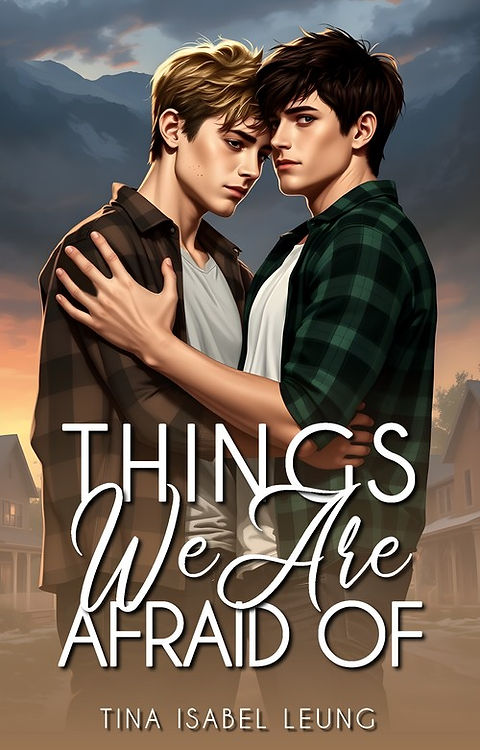

Tina Isabel Leung
Things We Are Afraid Of
Romance – Gay, North American Fiction, Coming of Age
⭐ You Are Currently Reading:
Tina Isabel Leung, Things we are afraid of, Part 1
You can finish reading this text in 1-2 hours. And if life gets in the way, that's okay—reading is a habit, not a race.
Let yourself get lost in the story, one page at a time. The book will be here whenever you are.
„Things We Are Afraid Of”
(Toby’s POV)
I couldn’t stop watching him. In the crowded school hallways, my eyes would find Travis without even trying—like he was somehow more in focus than everything else around him. The way he’d shift his backpack higher on his shoulder when it slipped. The careful way he’d check his watch between classes. The slight hesitation before he’d enter a room, as if preparing himself. For weeks now, I’d been trying to get closer, and for weeks, he’d been finding new ways to step back, each excuse more reasonable than the last. And yet, I couldn’t shake the feeling that the distance between us wasn’t what he truly wanted either.
“Sorry, I have to help my grandmother today,” he’d said last Tuesday, eyes sliding away from mine.
“Can’t. Work called me in,” he’d explained on Thursday, already turning toward the exit.
“Need to get home,” he’d murmured yesterday, checking his watch with an urgency that seemed both real and convenient.
I was beginning to collect these excuses like stones in my pocket—small, hard things I turned over in my palm when I was alone. Still, I kept noticing things. The phone calls he’d take in the hallway, speaking too quietly for anyone to hear. The careful way he packed his lunch, never wasting anything. How tired he looked sometimes, like he’d been awake all night. There was something happening in his life that I couldn’t see, something he wouldn’t let me see... and somehow, that only made me want to know him more.
Today, I caught him by his locker after calculus, moving quickly so he couldn’t slip away. “Hey,” I said, leaning against the metal door next to his, “do you want to maybe study for that history test? I could come over, or you could—“
“I can’t tonight,” he said immediately, not even looking up as he exchanged books. “My grandmother needs her medication changed and my mom’s working late.”
I stayed quiet, watching his hands—the way they paused briefly before continuing their task. It wasn’t a lie, I could tell; there was too much tired truth in his voice. But it was also not the whole reason.
“What about tomorrow?” I pressed, knowing I was pushing but unable to stop myself.
Travis glanced up then, finally meeting my eyes. Something flickered across his face—a brief, unguarded moment I couldn’t quite read. Regret? Longing? Whatever it was, it disappeared as quickly as it had come.
“Look, Toby... you’re a good friend,” he said softly, shutting his locker with a gentle click. “I’m sorry I’m not always the same for you.”
Friend. The word landed like a stone dropped from a height—simple, heavy, final. A year ago, I would have treasured it; now, it felt like a door closing. I nodded, swallowing against the sudden tightness in my throat. “It’s fine,” I lied, shifting my backpack. “I get it.”
But I didn’t get it. Not really. I understood that his home situation was complicated; I’d pieced together enough to know that. His grandmother was sick. His mother worked long hours. His father was... somewhere. Present but not always available. I knew all this, and still, I couldn’t shake the feeling that there was something else keeping him away from me—from everyone.
And then there was Brett.
A name I’d seen scribbled in the margins of Travis’s notebook, always carefully crossed out afterward. A name I’d caught him whispering once into a phone in an empty classroom, his voice soft in a way I’d never heard it. Brett. Who was he? What did he mean to Travis? The questions circled my mind like hungry birds, swooping down occasionally to peck at my thoughts.
I walked home alone that afternoon, Travis’s words still echoing. “You’re a good friend.” Friend. The autumn air was sharp with the smell of dying leaves, but I barely noticed, too busy dissecting those three syllables, trying to find something in them I might have missed. Some hint that maybe he meant something else, something more.
My house was silent when I arrived, as it always was. My parents wouldn’t be home for hours. I dropped my backpack in the hallway and headed straight for my room, not bothering with a snack. Laying on my bed, I stared at the ceiling, thinking about Travis’s careful distance, the way he guarded himself. What was he protecting? Or who was he protecting himself from?
And what did Brett have to do with any of it?
Sleep came for me somewhere in that circular thinking, dragging me under without warning. I dreamed of a forest—tall pines stretching up toward a slice of sky I could barely see. Ahead of me on a narrow dirt path walked Travis, his back straight, his pace steady. I tried to call his name, but no sound came out; my voice trapped somewhere behind my ribs. I tried to run, to catch up with him, but the distance between us never changed. Then he turned, just slightly, looking over his shoulder—not at me, but at something beside the path.
I followed his gaze and saw it there on the ground: a name scratched into the dirt. Brett. The letters were smudged, as if someone had tried to erase them with their palm, but they remained visible, stubborn. When I looked up again, Travis was gone—disappeared between the trees, leaving me alone with that half-erased name.
I woke with a start, my heart beating too fast, my shirt damp with sweat. The room was dark; I’d slept longer than I meant to. Rolling onto my side, I grabbed my phone from the bedside table. No messages. No missed calls. Just the time: 9:43 PM.
Outside my window, the neighbor’s pine tree swayed gently in the night breeze. Its shadowy branches reminded me of the forest in my dream, and suddenly I was thinking of Travis again. Of the name I’d seen. Brett. It wasn’t just a random word my subconscious had invented; it was real. Something—someone—from Travis’s life that he kept writing down and crossing out, as if he couldn’t decide whether to remember or forget.
Had Brett been Travis’s boyfriend? The thought hit me with unexpected force, a sharp pain beneath my ribs. I imagined them together—Travis and this faceless Brett—holding hands, laughing at private jokes, sharing the kind of closeness Travis never allowed with me. The images made my stomach twist. I hated these visions more than I could explain, even to myself.
But I couldn’t stop them from coming, couldn’t stop wondering. In the darkness of my bedroom, I finally admitted the truth I’d been dancing around for months: I wanted Travis to look at me the way I looked at him. I wanted to be more than his friend. And I was terrified that Brett—whoever he was—had already claimed the place I longed to occupy.
I rolled over, burying my face in my pillow, willing sleep to come back and take these thoughts away. But sleep stayed distant, and in the hollow silence of my room, all I could hear was Travis’s voice: “You’re a good friend.” And all I could think was: I don’t want to be your friend. I want to be something else entirely.
*
I splashed cold water on my face the next morning, trying to wash away the fragments of that dream. My reflection stared back at me from the bathroom mirror, eyes puffy from restless sleep, hair a mess of brown spikes. Behind me, the house was quiet—my parents already gone for the day, leaving nothing but the faint scent of coffee and the low hum of the refrigerator. But inside my head, it was anything but quiet. Brett. The name circled there like a persistent fly, impossible to swat away. Had Travis loved him? Did he still?
The thought made something twist in my chest—a sharp, unpleasant sensation I wasn’t used to feeling. I’d never been the jealous type before. Then again, I’d never wanted someone the way I wanted Travis.
I pressed my palms against the cool edge of the sink, leaning forward until my forehead nearly touched the glass. “Stop,” I whispered to myself, the word fogging the mirror briefly before disappearing. But the images wouldn’t stop—Travis holding hands with some faceless boy, Travis laughing at something this Brett had said, Travis letting him close in all the ways he kept me at a distance.
My hand tightened on the sink. I didn’t even know if Brett had been his boyfriend. Maybe he was just a friend. A cousin. Someone from his old neighborhood before they moved here. The rational part of my brain offered these possibilities, but something deeper, more instinctive, knew better. No one crosses out a name that many times unless it means something. Unless it hurts.
I dried my face roughly with a towel and headed back to my room to dress, but the thought followed me like a shadow. Travis and Brett. Brett and Travis. By the time I grabbed my backpack and headed out the door, the name had become a wound I couldn’t stop touching.
In calculus that morning, I barely heard a word. Travis sat three rows ahead and one seat to the left—close enough to see the back of his neck above his dark green flannel, the way his shoulders tensed when the teacher called on him, far enough that I couldn’t smell the faint pine scent that always seemed to cling to him. I spent the hour staring at the curve of his ear, wondering what secrets it had heard.
History class was different. Mrs. Garza was talking about the upcoming weekend when she suddenly changed topics.
“Before we dive into the Cold War, I have an announcement,” she said, setting down her chalk. “The school is organizing a weekend trip to San Juan Mountains in two weeks. We’ll visit a historic mining village, tour a folk art museum, and stay at a lodge for three nights. It‘s educational, but also...” she smiled, “a chance to get out of town. Permission slips are on my desk. First come, first served.”
The room immediately filled with excited whispers. Weekend trips were rare at our school; budget cuts had eliminated most field trips years ago. I glanced across the room at Travis, surprised to see genuine interest in his expression—the slight lift of his eyebrows, the way he leaned forward slightly in his seat. But then something crossed his face—a shadow, a resignation. His shoulders dropped almost imperceptibly, and I knew without him saying that he wouldn‘t be able to go.
His grandmother. His job. All the invisible ties that seemed to hold him in place.
Near the window, David packed his bag with his two friends, laughing about something. His blond hair caught the afternoon light, his smile easy and open. I barely knew him—just another senior who seemed perpetually surrounded by people who liked him. I had no idea what would happen to him on that trip. None of us did.
“Toby? You planning to go?” Mrs. Garza asked, catching me staring.
“Yeah,” I said quickly, not having realized I’d made the decision until the word was already out. “Definitely.”
I grabbed a permission slip on my way out, stuffing it into my backpack without looking at it. In the hallway, I searched for Travis but didn’t see him. Probably rushing to work, or home to his grandmother. Always somewhere else, always just out of reach.
Two weeks passed in a blur of homework, silent dinners with my parents, and nights spent staring at my ceiling, thinking about Travis and Brett and the trip that was rapidly approaching. I didn’t see much of Travis during that time—just passing glances in hallways, brief nods in class. Once, I caught him writing something in his notebook margin, his expression so intensely focused that I knew, without seeing, what name was flowing from his pen.
When the day of the trip finally arrived, I was surprised to spot Travis climbing onto the bus, backpack slung over one shoulder. Our eyes met briefly before he looked away, finding a seat near the middle. I slid into a spot two rows behind him, close enough to see the back of his head but far enough to pretend I wasn’t watching.
The bus ride was long, the windows fogging as we climbed higher into the mountains. Outside, scrubland gave way to pine forest gave way to aspen groves gone gold with autumn. Someone started counting elk on the hillsides. Someone else passed around a bag of chips that was empty before it reached the back row. I sat with my forehead against the cool glass, watching the world change as we ascended, thinking about how much space could exist between two people sitting only feet apart.
The village, when we finally arrived, was tucked into a mountain valley—narrow streets lined with Victorian-era brick buildings, a church with a weathered steeple, the whole place feeling like it had been frozen sometime in the 1890s. The air was thin and cold, carrying the scents of pine resin and woodsmoke.
“Everyone stick together,” Mrs. Garza called as we piled off the bus, our breath visible in small clouds. “First stop is the folk art museum.”
The museum was housed in a converted building near the center of town—dim rooms with low ceilings and wooden floors that creaked under our weight. Inside, display cases held carved wooden figures that the guide called “santos”—saints and spirits of the forest and stream, their faces stylized and somehow ancient-looking despite their relatively recent creation.
“These figures are part of a tradition that goes back centuries,” the guide explained, her voice soft in the hushed space. “The santero—the carver—sees his work as a form of prayer, a connection to something larger than himself.”
I wasn’t really listening. Instead, I watched Travis as he moved through the room, stopping longer than the others at certain displays, his fingers hovering just above the glass as if he could absorb something through proximity alone. There was a stillness to him here that I rarely saw at school—as if the quiet of the museum had seeped into him, allowing him to lower his guard just slightly.
Next, we visited the home and workshop of a working santero—an older man with weathered hands who demonstrated how he carved the figures from pine. The workshop smelled of wood shavings and linseed oil, tools hanging on the wall in a specific order that made it clear they were used rather than displayed. He let us hold an unfinished figure; it was lighter than I expected, the wood warm from his hands.
“You feel the shape that’s already in the wood,” he told us, running his finger along the grain. “You don’t force it. You just... help it come out.”
I glanced at Travis, finding him watching the santero with an intensity that surprised me. When the old man handed him a small carved figure to examine, Travis held it carefully, turning it over in his hands with a gentleness I’d never seen before. For a moment, I forgot all about Brett.
By late afternoon, we arrived at the lodge where we’d be staying—a three-story timber structure with wide porches and plank floors that creaked under our feet. Inside, the common areas were warm and slightly shabby—mismatched sofas, a stone fireplace, a long dining table with benches. The rooms we’d be sharing were small, with two narrow beds and wool blankets that scratched against my palm when I tested one.
“Room assignments are on the board,” one of the teachers called. “Drop your bags and meet downstairs in twenty minutes for orientation.”
I scanned the list, my heart speeding up when I saw my name paired with Travis’s. Three nights in the same small room. Three nights of listening to his breathing, watching him sleep, pretending I wasn‘t doing either.
Outside the lodge windows, the aspen trees shivered in the wind, their gold leaves catching the late afternoon light. In the distance, mountains rose sharp and ancient against a sky so blue it looked unreal. Everything here felt more vivid, more intense than at home—the cold, the colors, the silence that seemed to hang between the trees.
And standing in that unfamiliar room, watching Travis set his bag carefully on the bed furthest from the door, I wondered if maybe that was what I needed—this new place, this different air—to finally ask him about the name I couldn’t stop thinking about. Brett. The boy who might have had what I wanted most.
*
That evening, the lodge garden transformed under the gentle assault of twilight. Teachers and parent volunteers had set up a makeshift barbecue area near a fire pit ringed with stones, the smell of charcoal and grilling meat heavy in the mountain air. I stood in line for a burger, paper plate in hand, watching the sky shift from blue to purple above the aspen trees. The altitude made everything seem closer somehow—the stars appearing earlier and brighter, the air thinner but somehow more substantial in my lungs. When I finally reached the front of the line, Mrs. Garza handed me a slightly charred burger with a cheerful “Enjoy!” that seemed to encompass not just the food but the entire evening ahead.
I found a spot on a flat rock, balancing my plate on my knees, watching as others filled in around the unlit fire pit. The potato salad was clearly from a deli container, and the canned soda was already losing its chill in the cooling air, but somehow it tasted better than anything I’d eaten in weeks. Maybe it was the mountain air. Maybe it was just being away from the silence of my parents’ house.
After dinner, Mr. Peterson and a couple of seniors worked to build a bonfire, arranging logs in a careful structure that took three attempts and too many matches to finally catch. When it did, the flames rose quick and fierce, sending sparks spiraling up toward the emerging stars. Everyone gradually shifted, forming a loose circle around the fire, faces transformed by the flickering orange light.
I was watching the flames dance when I sensed someone settle onto the log beside me. Looking over, I found Travis there, his face half-illuminated by the fire, half-hidden in shadow. My heart did that stupid little jump it always did when he appeared unexpectedly. He nodded once in greeting, then turned his attention back to the fire.
We sat in silence for several minutes, listening to the wood crack and pop, the laughter of other students mingling with the night sounds of the mountains. Without planning to, I suddenly spoke.
“It‘s funny how fire can destroy things so easily,” I said, keeping my voice low enough that only he could hear, “but when you stare at it, you realize how beautiful it is. Like the things we‘re most afraid of are also the things that might be good for us.”
I hadn’t meant to say something so revealing. It had just... emerged, like the thought had been forming without my knowledge and finally found its way out. I glanced at Travis, trying to gauge his reaction.
He stayed quiet, his eyes fixed on the dancing flames. His profile was sharp against the darkness—the straight line of his nose, the slight furrow between his eyebrows as he considered my words. In the firelight, his skin looked warmer, his usual guardedness softened somehow.
Worried I’d made him uncomfortable, I tried to shift to safer ground. “Trip‘s more fun than I expected,” I offered, poking at the dirt with a stick. “Are you having fun?”
Travis turned to me then, his dark eyes reflecting tiny flames. “Actually, I am,” he admitted, sounding slightly surprised by his own answer.
“I‘m glad you came,” I said, feeling suddenly bold in the darkness. “When it was announced, I thought... well, I wasn’t sure you’d be able to.”
“My mom took extra shifts so I could miss work,” he explained, his voice quieter now. “She thought it would be good for me to go.”
I nodded, turning a small rock over in my palm. “When I was younger,” I found myself saying, “all my friends would go camping with their parents. But mine were always too busy.” I shrugged, trying to make it sound casual. “Work stuff.”
Travis’s expression shifted slightly—a softening around the eyes, a subtle nod. “I know the feeling,” he said simply.
Those four words created a bridge between us—small but real. “Well,” I said, tossing the rock toward the edge of the fire circle, “I’m glad this is the first real trip for both of us.”
He didn’t respond verbally, but I caught the slight upward tug at the corner of his mouth—not quite a smile, but close enough to make my chest feel warm in a way that had nothing to do with the fire.
Later, when everyone had showered and changed into pajamas or sweatpants, the lodge hummed with muffled activity. Several guys from our class had gathered in the main common room for a board game that seemed to involve more trash talking than actual playing. I could hear the shouts and laughter echoing up the stairs as I lay on my bed, trying to focus on my book.
Across the small room, Travis sat on the edge of his bed in flannel pajama pants and a faded t-shirt, his cell phone pressed to his ear. His voice was low, meant only for whoever was on the other end—his mother, I guessed from the snippets I could hear.
“Yeah, I’m fine... The medicine in the blue bottle, twice a day... I know... I know you will...” He paused, listening. “Thanks, Mom. For letting me come.”
I pretended to be absorbed in my book, but I was acutely aware of every shift in his posture, every subtle change in his tone. When he finally hung up, I risked a glance over the top of my page. He was staring at his hands, a complex emotion I couldn’t name playing across his features. Something like guilt, or maybe regret.
The realization hit me suddenly: he felt guilty for enjoying himself here, for being away from home where he was needed. But there was something else in his expression too—something that made me think his guilt wasn‘t only about leaving his family.
He looked up, catching me watching him. For a heartbeat, neither of us looked away. Then he quickly dropped his gaze, reaching for his own book on the nightstand, creating a barrier between us as effective as a wall.
The minutes stretched on, the pages of my book turning without me absorbing a single word. Outside our window, the wind picked up, rustling through the aspens, their leaves creating a sound like gentle applause. In the hallway, footsteps passed our door, voices fading as people headed to their rooms.
My stomach growled, breaking the silence. I hadn’t eaten much at dinner—too distracted by Travis‘s unexpected proximity at the fire.
“Hungry?” I asked, surprising myself with the question.
Travis looked up from his book, equally surprised. “A little,” he admitted.
“I‘m craving a late-night snack,” I said, setting my book aside and standing. “Want me to grab you something? I saw vending machines downstairs.”
He hesitated, then nodded. “Sure. Thanks.”
I slipped on my shoes and headed downstairs, my mind buzzing with the simple fact that he’d said yes to something—however small. The vending machine offered limited options; I fed in my dollar bills and made my selection, then headed back upstairs.
When I returned, I handed Travis a bag of plain salted potato chips. His eyes widened slightly as he took it.
“I’ve never had potato chips this late at night,” he admitted, turning the bag over in his hands.
I laughed, settling back onto my bed and opening my own bag. “Somehow unhealthy food tastes best at night. Especially when you’re not supposed to be eating it.”
He opened the bag carefully, taking a single chip out and eating it slowly. I watched him from the corner of my eye, trying not to make it obvious.
“Plain salted,” he noted, looking at the bag. “That’s my favorite.”
“Mine too,” I said, surprised. “Everyone else always wants the weird flavors.”
“Plain is underrated,” he agreed, a hint of a real smile playing at his lips.
It was such a small thing—this shared preference for the most basic potato chip flavor. Trivial, really. And yet sitting there in our shared room, the soft crinkle of chip bags the only sound between us, it felt like we‘d discovered something important about each other. Something real.
Travis took another chip, eating it thoughtfully. In the soft lamp light, his guard seemed to lower just slightly—enough that I could see the person beneath the careful distance he maintained. And what I saw made my heart beat faster.
He glanced up, catching me watching him again, but this time he didn’t look away immediately. Something passed between us—a moment of recognition, maybe. Or possibility. His eyes, always so carefully guarded, seemed to ask a question neither of us was ready to voice.
Then he blinked, and the moment shattered. He crumpled the top of his chip bag closed, even though it was still half full.
“I should brush my teeth,” he said abruptly, standing.
I nodded, not trusting my voice. He grabbed his toothbrush and left the room quickly, the door clicking shut behind him.
Alone, I let out a breath I hadn’t realized I was holding. What was happening between us? There were moments when I was certain there was something—some current running beneath the surface of our interactions. And then there were moments when he seemed to be building walls higher than before.
When he returned ten minutes later—far longer than it should take to brush teeth—his face was composed again, his eyes avoiding mine. He got into bed without a word, turning his back to the room.
“Goodnight,” I said softly.
“Night,” he replied, his voice neutral, giving nothing away.
I turned off the lamp between our beds, plunging the room into darkness. Outside our window, the aspen leaves continued their gentle applause, as if acknowledging a performance only they had fully witnessed. I lay awake for a long time, replaying that moment with the chips, the brief unguarded look in his eyes, wondering if I’d imagined the whole thing.
But as sleep finally began to pull me under, one thought remained clear: something had shifted tonight. I just wasn’t sure if it had shifted in the direction I hoped.
*
Travis and I were returning from an afternoon hike when we first sensed that something was wrong. The lodge’s entrance hall, usually filled with the casual chaos of backpacks and muddy boots, felt unnaturally tense. Voices drifted from the teacher’s temporary office—Mr. Peterson’s low, stern tone punctuated by another voice that sounded close to breaking. I caught Travis’s eye, his expression mirroring my own confusion. Then Mrs. Garza emerged from the dining area, her face tight with concern, and whispered something to another chaperone. The word “fight” floated toward us, followed by “hospital” and “parents called.” My stomach dropped as we moved closer, instinctively seeking the source of the disruption.
A small crowd had gathered near the office door—not pressing close enough to hear everything, but near enough to catch fragments. I recognized Lisa from my English class, her eyes wide as she leaned toward her friend.
“David told them he’s gay,” she whispered, not noticing us approach. “And they just... they lost it. Two against one.”
“Jesus,” her friend murmured. “Is he okay?”
Lisa shook her head slightly. “His face is pretty messed up. But get this—Mr. Peterson’s in there lecturing him. Like it’s his fault for telling them.”
I felt a sudden chill that had nothing to do with the mountain air seeping through the lodge‘s old windows. Beside me, Travis had gone very still, his face unreadable except for a slight tightening around his eyes. The office door was partially open, allowing slivers of the conversation to escape.
“—not saying what they did was right, David.” Mr. Peterson’s voice carried clearly now. “Obviously, violence is never the answer. They’ll be disciplined appropriately. But you have to understand, when you tell people things like that—“
“Things like what?” David’s voice was thick, as if speaking through a swollen lip. “That I‘m gay? That’s not a ‘thing,’ that‘s who I am.”
“It’s a private matter,” Mr. Peterson insisted, his tone shifting to something that probably sounded reasonable to his own ears but made my skin crawl. “People have always kept these things to themselves. Gay people, lesbian people—they’ve lived together as ‘roommates’ for decades. Everyone knew, nobody bothered them. They kept a low profile and everything was fine.”
There was a brief silence, and I could picture David sitting there with his bruised face, absorbing these words that somehow hurt more than fists.
“I don’t want to live like that,” David finally said, his voice steadier now, clearer. “I don’t want to lie about who I am and spend my whole life hiding.”
I heard Mr. Peterson sigh—the weary sound of a man who believed he was being exceptionally patient. “That’s very idealistic, David. But this is the real world. And in the real world, some things are better left unsaid.”
The crowd around us had grown quiet, everyone straining to hear. I glanced at Travis again and found him staring at the partially open door with an intensity that startled me. His jaw was clenched, a muscle flickering along its edge. I couldn’t tell if he was angry at David for coming out or at Mr. Peterson for his response—and the uncertainty made my chest tighten with sudden anxiety.
What would Travis think if he knew how I felt about him? Would he see it as something better left unsaid?
The office door swung open fully, and David emerged. His left eye was swollen nearly shut, a dark purple bruise spreading across his cheekbone. His lower lip was split, a small crust of dried blood at the corner of his mouth. He walked with his head up, though, refusing to look cowed despite the damage to his face. Behind him, Mr. Peterson stood in the doorway, his expression a mix of frustration and what he probably thought was concern.
“David,” he called, making the boy pause. “Remember what I said. Low profile from here on out. This will all blow over.”
David didn’t respond. He simply turned and walked through the parting crowd, heading for the stairs. No one spoke to him as he passed. No one offered help or comfort. They just watched, their silence its own kind of violence.
Later that evening, after a strained dinner where David sat alone at the end of a table and no one quite knew where to look, I was reading in the common room when I noticed Travis slip quietly out the side door leading to the garden. Something in his purposeful movement caught my attention, and I found myself at the window, watching as he scanned the darkening garden as if searching for someone.
The garden was large and slightly wild, bordered by an aspen slope on one side. In the fading light, I could make out the remains of last night’s bonfire—a circle of stones surrounding cold ash. Travis moved past it, heading toward the far wall where a wooden bench sat partially obscured by an overgrown shrub. As he approached, I realized someone was already sitting there—a solitary figure hunched slightly against the evening chill.
David.
I couldn’t hear what they were saying through the glass, but I watched as Travis hesitated briefly before sitting down beside him on the bench. There was a careful distance between them at first—maybe a foot of weathered wood separating their bodies. Travis spoke first, his profile serious in the deepening twilight. David’s response was brief, his injured face turned slightly away.
I pressed closer to the window, my breath fogging the glass. I shouldn’t be watching this; it felt invasive somehow. And yet I couldn’t make myself turn away. There was something happening out there that seemed important—not just for David or Travis, but somehow for me too.
Travis was speaking again, longer this time, his hands moving slightly as they did when he felt strongly about something. I could only guess at his words, but his posture conveyed a gentle certainty. Eventually, David nodded, then nodded again more firmly. When he finally turned to face Travis fully, there was something like gratitude in his posture—the slight straightening of shoulders that had been carrying too much weight.
They sat in silence for a while after that, looking out at the garden as twilight deepened into true darkness. Finally, David said something that made Travis dip his head in acknowledgment. I caught the words “good friend” on David’s lips just before he stood, brushed off his pants, and headed back toward the lodge entrance.
Travis remained on the bench, alone now. He didn’t move for a long time, just sat there looking at something I couldn’t see—maybe the first stars appearing above the trees, or maybe nothing at all. In the dim light from the lodge windows, his face looked different somehow—softer and yet more resolved.
When he finally stood and turned toward the lodge, I stepped quickly away from the window, not wanting to be caught spying. But as I hurried back to my abandoned book, my mind was racing. I had just witnessed something raw and genuine—Travis comforting someone who’d been hurt for simply being honest about who he was. And while I hadn’t heard his words, I’d seen enough to know that Travis hadn’t shunned David or repeated Mr. Peterson’s toxic advice.
Instead, he’d sat beside him in the darkness. He’d listened. He’d offered whatever comfort he could.
What did that mean? Was Travis simply being kind to someone who’d been mistreated? Or was there something more personal in his response—some recognition, some solidarity I was afraid to name?
And what about me? If I’d been the one to come out—to say aloud the things I barely let myself think about—would I have found Travis sitting beside me on that bench? Or would I have sat alone, nursing bruises both seen and unseen?
As Travis reentered the common room, our eyes met briefly. Something passed between us—a question, maybe, or the shadow of one. Then he looked away, heading for the stairs and our shared room above. I stayed behind, pretending to read while the words blurred on the page, thinking about courage and silence and the high cost of both.
I thought about David, his face bruised but his spine straight. I thought about Mr. Peterson, so certain that invisibility was the answer. And I thought about Travis, sitting on that bench in the gathering darkness, offering the one thing no one else had bothered to give David today: the simple gift of presence.
Later, when I finally went upstairs, Travis was already in bed with his back to the room, his breathing too measured to be genuine sleep. I slipped under my own covers quietly, not wanting to disturb whatever thoughts were keeping him awake. Outside our window, the aspen leaves rustled in a nighttime breeze—the sound like countless whispered secrets finally finding voice.
*
Two hours after witnessing Travis’s kindness toward David, I stood in our shared room, watching Travis pack his day bag with methodical precision. My heart hammered against my ribs, the question about Brett burning in my throat like a coal I’d been holding too long. The words I’d been rehearsing all afternoon sat ready on my tongue, but instead what came out was: “Want to take a walk around the garden before dinner?” My voice sounded normal enough—casual, even—but something in my expression must have betrayed me because Travis paused, his hands going still on his half-folded sweater.
“Sure,” he said after a moment, studying me with that careful gaze of his. “Everything okay?”
“Yeah,” I lied, already turning toward the door. “Just need some air.”
Outside, the late afternoon light slanted through the aspen trees, casting long shadows across the garden path. The air smelled of pine and approaching cold—sharper now as evening settled into the valley. Neither of us spoke as we crossed the space where the bonfire had been, the stones still ringed around a patch of blackened earth and ash.
I led us past the flowerbeds, where summer’s last efforts had long since withered. Brown stems reached up from the soil like desperate fingers, collapsed petals scattered beneath them. Beyond these, a low wooden fence marked the garden’s edge, and past that stood a small grove of coniferous trees. They were scrubby and thin, struggling at this elevation, their branches sparse against the deepening blue of the sky.
Travis followed me silently, his footsteps crunching softly on the gravel path. I could feel his growing concern like a physical presence between us. Twice he glanced at me with a question in his eyes, but I kept walking, not trusting myself to speak until we reached the right place—somewhere private, somewhere the words could exist without immediately evaporating into the vastness of everything unsaid between us.
We entered the small grove, the ground beneath our feet softened by years of fallen needles. Here, the trees provided a fragile barrier from the lodge, creating the illusion of solitude even though we were barely fifty yards from the building. I stopped walking and stood with my back to Travis, taking a deep breath of the resin-scented air.
“Toby?” Travis’s voice was cautious. “What’s going on?”
I turned to face him, studying the way the filtered light caught in his dark hair, the slight furrow between his eyebrows, the tension he carried in his shoulders. All these details I’d memorized without intending to.
“I saw you,” I said finally. “With David. Earlier.”
Something shifted in Travis’s expression—relief, maybe, that this was about David and not something else. “Oh,” he said. “Yeah, I just... thought he could use someone to talk to.”
“That was good of you,” I replied, meaning it. Then, before I could lose my nerve, I added, “Who’s Brett?”
The effect was immediate—like I’d struck him. Travis went perfectly still, his eyes widening just enough to confirm what I’d suspected: Brett wasn’t just a name. He was something important, something Travis had tried to keep hidden.
“Where did you—“ he started, then stopped. Understanding dawned on his face. “My notebooks.”
It wasn’t a question. He knew I’d seen him writing that name, crossing it out, writing it again.
“Yeah,” I admitted. “And you mentioned him once, on the phone. I wasn’t trying to eavesdrop, but...” I let the sentence hang unfinished.
Travis’s gaze dropped to the ground, his jaw working slightly as if he was chewing on words he wasn’t ready to release. The silence stretched, filled only by the soft rustle of needles above us and the distant call of a bird somewhere in the valley below.
“He was someone I knew,” he finally said, his voice carefully neutral. “From before we moved here.”
“Someone you knew,” I repeated, the words tasting bitter. “That’s it? Because you don’t write someone’s name over and over if they’re just ‘someone you knew.’”
Travis’s head snapped up, a flash of anger or maybe fear in his eyes. “What do you want me to say, Toby?”
“The truth,” I said simply. I was tired of guessing, tired of the space between what we said and what we meant. “Was he your boyfriend?”
For a moment I thought he might walk away. His body tensed like he was preparing for flight, eyes darting toward the path we’d come down. But then his shoulders dropped slightly, defeat or maybe just exhaustion softening his posture.
“It matters to you, doesn’t it?” he asked, his voice quieter now. “What I say about him.”
The question caught me off guard. Of course it mattered—it mattered more than I wanted to admit. But I couldn’t find the words to explain why without revealing too much of myself.
“I just want to understand,” I said instead.
Travis drew a deep breath, releasing it slowly through his nose. “Brett and I were... close,” he finally said. “I felt something for him. He kissed me once, but that was it. He moved away three weeks later. Never mentioned it again.”
The confirmation hit me like a physical blow, even though I’d already known it in some deep, instinctive way. Brett had been someone Travis cared about—someone who had touched him and then left. The jealousy I’d been fighting rose up again, sharper now that it had a real target, a real story to attach to.
“So you’re gay?” The question came out more abruptly than I’d intended.
Travis’s eyes met mine, holding my gaze steadily for the first time since we’d entered the grove. “I don’t know,” he said carefully. “Maybe a little. If I like somebody, I’ll just be with them. Gender doesn’t really matter to me.”
Something in his careful phrasing made me wonder if he was thinking of someone specific—if there was a current “somebody” beneath his hypothetical words. The thought made my heart beat faster.
“What about you?” Travis asked suddenly, turning the question around with such smoothness I almost missed the strategic shift.
“What about me what?” I stalled, though I knew exactly what he was asking.
“Are you gay?” His voice was neutral, but his eyes were intent on my face, watching for the slightest reaction.
I felt heat climb my neck. This wasn’t how I’d planned the conversation. I was supposed to be the one asking questions, getting answers—not standing here with my own secrets suddenly under examination.
“I don’t know,” I said with a shrug that felt wooden, unconvincing. “I don’t really want to talk about these things right now.”
Travis raised his eyebrows slightly, the gesture so subtle it might have been missed by someone who wasn’t watching him as closely as I always did. “You don’t want to talk about it,” he repeated slowly. “But you wanted me to.”
Put like that, it sounded unfair—selfish, even. But I wasn’t ready. Not yet. Not when I still couldn’t read what Travis was thinking, what he wanted, what all this meant to him.
“It’s different,” I said weakly.
“Is it?” Travis’s voice was soft but not gentle.
We stood there in the grove, surrounded by weak trees and dying light, the unspoken things between us piling up like fallen needles on the forest floor. The breeze picked up, making the branches above us sway and creak. In the distance, I could hear voices from the lodge—dinner preparations, perhaps, or other students returning from their own walks.
“We should head back,” Travis said finally, already turning toward the path. “It’ll be dark soon.”
I watched him take a few steps, his back straight, his pace measured. Always so controlled, always so careful. But I’d seen the crack in his composure when I‘d said Brett’s name. I’d glimpsed something raw and real beneath the surface he showed the world.
As I followed him back through the grove, past the dead flowerbeds and the cold bonfire ring, I tried to convince myself that it was enough—that knowing about Brett, confirming what I’d suspected, was what I’d wanted all along. But deep down, in the honest place I rarely visited, I knew that wasn’t true.
What I wanted was for Travis to look at me the way I looked at him. What I wanted was to be more important than a boy who’d kissed him once and left. What I wanted was to be brave enough to answer his question truthfully, to say: Yes, I think I am. At least for you.
Instead, I walked silently beside him, the space between our shoulders feeling wider than it had been yesterday, the words I couldn’t say growing heavier with each step back toward the lodge.
*
(Travis’s POV)
The next two days passed in an atmosphere so thick with awkwardness I could almost taste it—metallic and stale, like the air before a storm that refuses to break. Toby and I still talked, but the conversations were hollow shells, each word carefully examined for hidden meanings before being offered. We discussed homework. The weather. Whether the hot water in the showers would hold out for everyone. Mundane things that required no risk, that kept us safely on the surface of whatever was happening between us. All the while, I couldn’t stop the anxiety building in my chest that he had judged me for what I’d revealed about Brett, about myself, and was now slowly backing away from our friendship.